
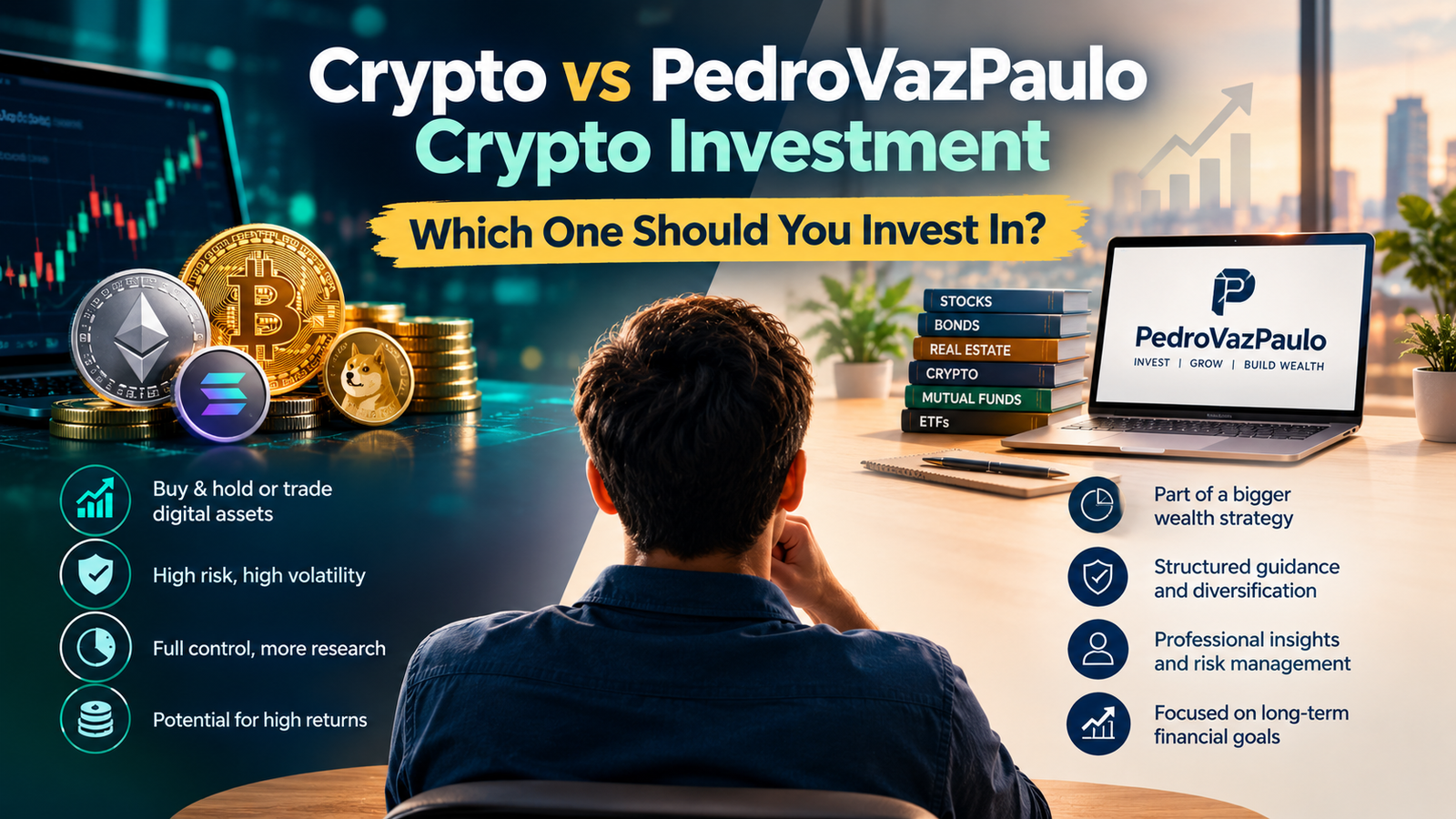
If you’ve searched for crypto vs PedroVazPaulo crypto investment, you’re probably trying to answer a simple question: where should your money go?
Should you buy cryptocurrency yourself and manage the investment on your own? Or should you follow the kind of structured crypto investment approach associated with PedroVazPaulo?
There’s an important distinction here.
Crypto is an asset class. Bitcoin, Ethereum and other digital assets are things you can buy, hold, trade or sell. PedroVazPaulo is associated with an investment and consulting framework that treats crypto as one part of a wider wealth strategy. Its official site describes crypto investing as a high-risk allocation that should sit alongside other assets rather than replace a core portfolio.
So the real comparison is between self-directed crypto investing and a structured investment approach.
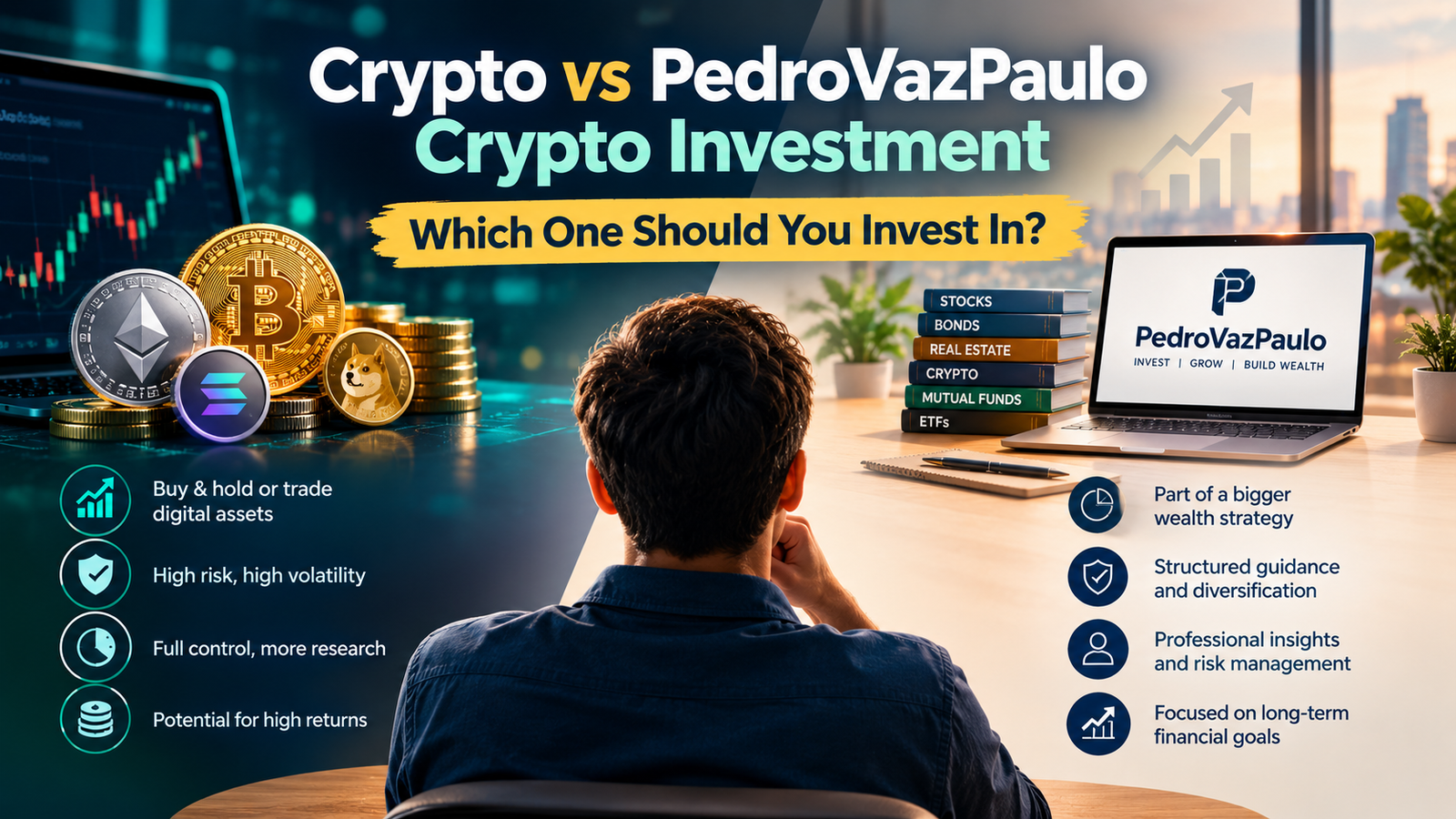
And your answer depends heavily on how much risk you can handle, how much time you have, how much you understand crypto and what the money is supposed to do for you.
Table of Contents
Crypto vs PedroVazPaulo: quick comparison
| Factor | Direct crypto investing | PedroVazPaulo-style approach |
|---|---|---|
| What you invest in | Digital assets such as Bitcoin or Ethereum | Crypto as one part of a broader investment plan |
| Decision maker | You | Investor with an advisory framework |
| Risk level | High | Still high for the crypto portion |
| Diversification | Depends on you | Diversification is part of the stated approach |
| Portfolio size | Can be very small or large | Usually considered alongside wider wealth |
| Research required | High | Lower for investors using professional guidance |
| Control | Full personal control | Depends on the advisory arrangement |
| Security responsibility | Mostly yours | Depends on the service and custody arrangement |
| Suitable for beginners | Possible, but education is needed | Potentially easier to structure, but credentials still need checking |
| Guaranteed returns | None | None |
| Best use | Investors comfortable managing their own crypto | Investors who prefer a structured wealth approach |
The table tells you something important.
PedroVazPaulo isn’t another cryptocurrency that you can buy instead of Bitcoin or Ethereum. The comparison is really about how you approach crypto investing.
How ai is changing the view the real estate
What is crypto investing?
Crypto investing means buying digital assets with the expectation that their value will rise over time or that they can provide some other financial use.
Bitcoin is the best-known example. Ethereum is another major digital asset with a blockchain that supports applications and smart contracts.
There are thousands of other tokens, but that doesn’t mean thousands of good investments.
That’s where things get messy.
A crypto investor has to decide what to buy, when to buy it, how much money to put into it, where to store it and when to sell.
You also have to live with large price movements.
A stock can fall 10% and make you uncomfortable. Crypto can move that much in a much shorter period, especially when sentiment turns quickly.
RBI has repeatedly warned Indian users about risks linked to virtual currencies, including volatility, security problems, loss of access and legal or customer-protection concerns.
That doesn’t mean every crypto investment will lose money.
It means you need to treat the risk seriously before putting your savings into it.
What does PedroVazPaulo crypto investment mean?
The term PedroVazPaulo crypto investment is generally used in connection with the crypto investment guidance published by PedroVazPaulo.com.
Its official crypto investment material describes cryptocurrency as a high-risk part of a broader wealth plan. The approach focuses on understanding digital assets, deciding how much of a portfolio should be exposed to crypto and protecting the rest of the investor’s financial position.
The official site also describes crypto consulting as guidance for founders and investors who want to include digital assets within a wider investment strategy.
That distinction matters when you’re searching online.
Some websites use the PedroVazPaulo name and describe crypto platforms, investment systems or services in very different ways. The official site itself warns that other domains using the name aren’t affiliated with it.
So if someone approaches you claiming to be a PedroVazPaulo crypto representative and asks you to send money to a personal wallet, website or unknown platform, stop first.
Verify who you’re dealing with.
A name appearing in a Google search isn’t proof that the person or platform contacting you is genuine.
Is PedroVazPaulo a cryptocurrency?
No.
This is one of the easiest mistakes to make when searching the phrase.
PedroVazPaulo isn’t a cryptocurrency like Bitcoin.
There isn’t a PedroVazPaulo coin that you need to buy to participate in its investment philosophy.
The term refers to consulting and investment content around different asset classes, including crypto. The official site lists crypto investments alongside stocks, bonds, mutual funds, ETFs and real estate in its investing section.
So you shouldn’t compare:
Bitcoin vs PedroVazPaulo
as if they’re two competing coins.
A better comparison is:
Self-managed crypto investing vs a structured crypto investment strategy.
That’s much closer to what you’re actually deciding.
Why people choose direct crypto investing
Direct investing gives you control.
You choose the asset.
You choose the exchange.
You decide how much to invest.
You decide whether to hold for 5 years or sell tomorrow morning because Bitcoin just moved 8%.
That control can be useful if you already understand the market.
For example, an investor might decide to put ₹50,000 into Bitcoin and hold it for several years. Another person might split ₹50,000 between Bitcoin and Ethereum.
The important part is that the investor understands what those decisions mean.
Direct crypto investing also makes it easier to start with a small amount.
You don’t need to build a complicated portfolio on day 1.
But there’s a catch.
You become responsible for almost everything.
If you choose a poor asset, that’s your decision.
If you use weak security, that’s your problem.
If you panic-sell after a sharp fall, there’s nobody else to blame.
And crypto markets don’t care whether you’ve researched for 2 hours or 200 hours.
Why some investors prefer a structured approach
Some people simply don’t want to make every investment decision themselves.
They may have a business, a full-time job, family responsibilities or several investments already.
For them, a framework can make the process easier to manage.
The PedroVazPaulo investment material puts attention on diversification, risk tolerance, portfolio construction and position sizing. Crypto is treated as a high-risk allocation rather than the entire wealth plan.
That’s a sensible way to think about crypto.
Imagine you have ₹10 lakh in total savings.
Putting ₹10 lakh into one volatile digital asset creates a completely different financial situation from putting a small portion into crypto while keeping money in other assets.
Your investment decision should start with your total financial position.
The crypto purchase comes later.
How much should you invest in crypto?
There’s no universal percentage that works for everyone.
Someone with ₹1 crore in investments, a stable income and years of market experience has a different risk capacity from someone with ₹2 lakh in savings and an unstable monthly income.
The second person has less room for a major loss.
A practical way to think about it is to ask:
If this investment lost 50%, would my daily life change?
If the answer is yes, the position is probably too large.
And if losing the entire amount would create serious financial problems, that money shouldn’t be treated like speculative capital.
The official PedroVazPaulo crypto investment guide makes a similar point by describing crypto as a high-risk allocation and stating that investors should only put in money they could afford to lose.
That’s a much healthier starting point than chasing a token because someone posted a screenshot showing a huge profit. Ready-to-Move vs Under-Construction Property: Which One Should You Buy?
Bitcoin vs smaller cryptocurrencies
This is another area where beginners can get into trouble.
Bitcoin is widely known and has been around since 2009.
Smaller cryptocurrencies can move much faster.
That sounds attractive when prices are rising.
But the same thing works in the opposite direction.
A token that rises 100% can also fall 70% or 90%.
Some projects have little real use. Some lose liquidity. Some disappear completely.
So buying something because it is cheap can be a poor reason to invest.
A ₹1 token isn’t automatically cheaper than a ₹50,000 token.
The price of one coin tells you very little by itself.
You need to look at the project’s market value, supply, usage, liquidity, development activity and the risks surrounding it.
Crypto investment and diversification
Diversification sounds boring until one investment falls sharply.
Suppose you have ₹5 lakh.
Investor A puts the entire amount into one cryptocurrency.
Investor B keeps part of the money in traditional assets and puts a smaller portion into crypto.
If the crypto market crashes, Investor A feels the entire move.
Investor B still takes a hit, but the rest of the portfolio can soften the damage.
This is why the PedroVazPaulo approach treats crypto as part of a broader investment plan rather than the complete plan.
Diversification doesn’t eliminate losses.
It changes how much one investment can damage your overall financial position.
That’s a big difference.
The biggest risk with crypto isn’t always price
Price volatility gets most of the attention.
Security deserves just as much.
Crypto ownership depends heavily on access credentials, wallets and private keys.
If you lose access to a wallet or expose sensitive credentials to someone else, recovering the assets can be difficult or impossible.
RBI has previously warned about risks involving hacking, compromised passwords, malware and the loss of access to digital wallets.
So an investment plan needs a security plan too.
Use strong account protection.
Keep recovery information secure.
Be extremely careful with links and messages.
Don’t send money because someone promises guaranteed returns.
And don’t give a stranger access to your wallet because they claim they’re helping you make profits.
What about crypto scams using investment brands?
This deserves its own section because the internet has made financial impersonation easier.
A website can look professional.
It can have charts, testimonials, fake account balances and a convincing investment calculator.
None of those things prove that the operation is genuine.
SEBI warns investors to be cautious with unregistered entities, guaranteed returns, pressure to invest quickly and investment schemes that don’t provide proper documentation.
This becomes especially important when a well-known name is involved.
If you see “PedroVazPaulo crypto investment” in an advertisement, don’t assume the advertisement is connected to the official business.
Check the domain.
Check the contact information.
Check who is asking for your money.
Check whether the service is actually what it claims to be.
And never let urgency make the decision for you.
Crypto taxation in India
Indian investors also need to consider tax before calculating their expected returns.
The Income Tax Department states that gains from Virtual Digital Assets are subject to a 30% tax under Section 115BBH, along with applicable surcharge and 4% cess. The department also provides a separate Schedule VDA for reporting VDA transactions in ITR-2 and ITR-3.
So imagine you make a ₹1 lakh gain.
You shouldn’t automatically think of the entire ₹1 lakh as money available to spend.
Tax can reduce what you actually keep.
There are also specific rules around losses and how VDA income is reported, so large or frequent transactions deserve proper tax advice.
The rules can change, too.
If you’re investing serious money, speak with a qualified tax professional rather than relying on a random crypto calculator.
Crypto vs PedroVazPaulo: which is better for beginners?
For a complete beginner, the better starting point is education.
Buying crypto first and learning later can become an expensive lesson.
A structured investment approach can help because it forces you to think about risk, allocation and the reason for owning the asset before you buy it.
But there’s another point people sometimes miss.
Following an investment framework doesn’t remove investment risk.
If the underlying crypto falls 50%, your portfolio still feels that fall if you own it.
A framework can improve decision-making.
It can’t control the market.
Which approach is better for a long-term investor?
For a long-term investor, I prefer the structured approach.
Here’s why.
A 10-year investment plan needs more than an asset that you hope will rise.
You need to know how much you can invest, how much you can lose, how you will react during a crash, when you will rebalance and what other assets you own.
Crypto can have a place in that plan.
It just shouldn’t automatically become the entire plan.
The official PedroVazPaulo investing framework also puts broader portfolio construction ahead of treating crypto as a standalone path to wealth.
Who should consider direct crypto investing?
Direct crypto investing can make sense for someone who:
- Understands how crypto wallets and exchanges work.
- Can handle large price movements without panic selling.
- Has emergency savings outside the crypto portfolio.
- Doesn’t need the invested money in the near term.
- Understands the tax rules that apply to their situation.
- Is willing to research assets before buying them.
- Can keep account and wallet security under control.
If you can’t check most of these boxes, slow down.
There will always be another crypto opportunity tomorrow.
Who might prefer a PedroVazPaulo-style investment framework?
A structured approach may suit you if:
- You already have several types of investments.
- You don’t want crypto to dominate your portfolio.
- You want to think about risk before choosing an asset.
- You prefer a written investment plan.
- You have limited time to research markets.
- You want crypto to sit inside a wider wealth strategy.
The key word is framework.
Don’t treat any consultant, website or investment article as a substitute for checking the actual service, registration, fees, custody arrangements and risks.
What should you check before investing through anyone?
Before sending even ₹1,000, ask these questions.
Who receives my money?
If the answer is a personal bank account or an unknown wallet, stop.
Where are my assets held?
You should know whether you control the assets or whether another party controls them.
What are the fees?
Trading fees, management fees, withdrawal fees and spreads can reduce returns.
What happens if the investment falls?
A legitimate investment discussion should be able to explain downside risk.
Are returns guaranteed?
If someone promises guaranteed crypto returns, walk away.
SEBI specifically warns investors about guaranteed or near-certain returns and recommends checking the credentials of people or entities offering investment strategies.
A simple example with ₹1 lakh
Let’s say you have ₹1 lakh available for long-term investing.
One option is to put the entire amount into crypto.
If the market rises sharply, your portfolio can rise sharply too.
If the market falls sharply, the same ₹1 lakh can become ₹50,000 or less.
Another approach is to decide that only a smaller part of your overall portfolio belongs in crypto.
You might then invest ₹20,000 in crypto while keeping the remaining ₹80,000 in other investments that fit your financial plan.
The exact percentage isn’t the point.
The point is position size.
A risky investment becomes much easier to survive when its size is appropriate.
Crypto vs PedroVazPaulo: final verdict
So, which one should you invest in?
If you’re asking whether you should buy “PedroVazPaulo” instead of crypto, the answer is simple: you can’t.
PedroVazPaulo isn’t a cryptocurrency or a stock.
It’s associated with an investment and consulting approach where crypto is treated as one high-risk asset within a wider wealth strategy.
If you’re choosing between managing crypto yourself and using a structured investment approach, the second option makes more sense for investors who don’t have the time or experience to manage every part of their crypto exposure.
Experienced investors who understand wallets, exchanges, taxes and market volatility may prefer to manage their own positions.
For beginners, I’d start smaller.
How AI is changing the Home In the real estate
Learn first.
Invest second.
And keep enough money outside crypto that a bad year in the digital-asset market doesn’t wreck your finances.
Final thoughts
Crypto can have a place in an investment portfolio.
The mistake is treating a volatile asset like a guaranteed savings account.
If you choose direct crypto investing, understand what you’re buying and accept that prices can move violently.
If you prefer the PedroVazPaulo-style approach, focus on the investment framework rather than looking for a magic coin or guaranteed return.
Your portfolio should fit your income, savings, time horizon and ability to handle losses.
And before sending money to anyone using a crypto investment brand, verify the exact entity first.
A good investment decision should still make sense on a boring Tuesday when nobody is promising you 20% next month.
PedroVazPaulo a crypto investment platform?
PedroVazPaulo a crypto investment platform?
The official PedroVazPaulo website presents its crypto work as investment guidance and consulting, not as a cryptocurrency exchange or a coin that investors purchase.
Be careful with third-party websites that use the PedroVazPaulo name and ask you to deposit funds.
Can crypto make you rich?
It can generate large gains, but it can also produce large losses.
Anyone promising guaranteed wealth from crypto is giving you a reason to be suspicious.
Is PedroVazPaulo better than investing in Bitcoin?
They’re different things.
Bitcoin is a digital asset.
PedroVazPaulo is associated with an investment and consulting framework that can include crypto as part of a broader portfolio.
The useful comparison is between buying and managing crypto yourself versus following a structured investment process.