
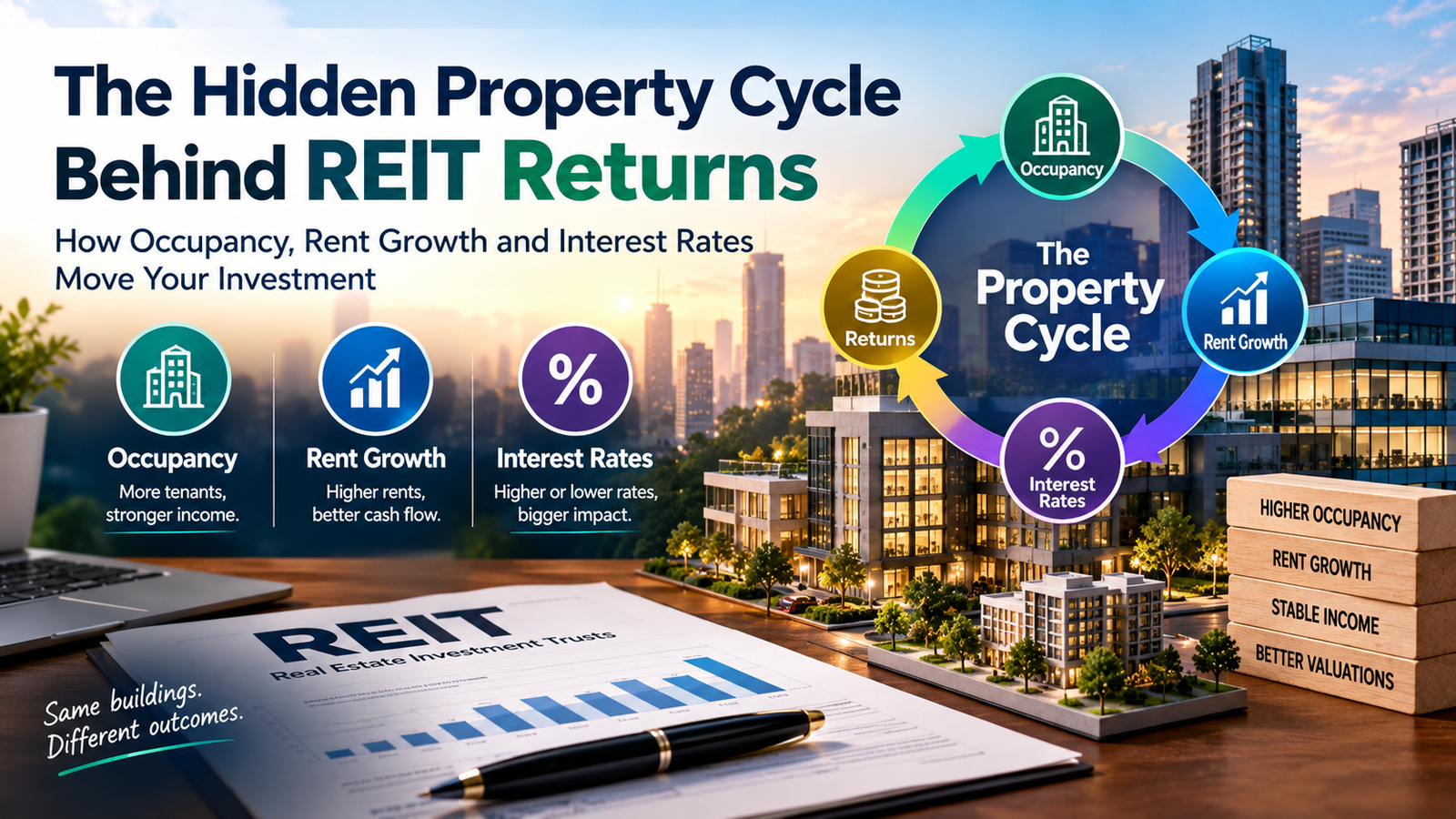
REIT investing can look deceptively simple.
You buy units of a real estate investment trust, collect distributions and wait for the value of the investment to grow.
But there’s a property cycle running underneath those numbers.
A REIT owns or manages income-producing property, so its financial performance depends heavily on what happens inside those buildings. A shopping centre with empty stores behaves differently from one where every unit has a tenant. An office property with rising rents produces a different result from one where landlords are cutting rents just to keep companies from leaving.
Then interest rates enter the picture.
This is where REIT investing gets interesting.
Occupancy, rent growth and interest rates can push REIT returns in completely different directions at different points in the property cycle.
You might see a REIT’s property income rising while its market price falls because borrowing costs have increased.
Or you might see rents growing slowly while the REIT’s valuation improves because investors expect interest rates to fall.
The property itself hasn’t moved.
The market’s view of that property has.
Table of Contents
Why REIT returns follow a property cycle
Real estate doesn’t move in a straight line.
A new commercial building takes time to fill. Once occupancy improves, landlords gain pricing power. Rents can then rise, property income improves and investors become more comfortable paying higher prices for the REIT.
Eventually, however, expensive property prices can attract more construction.
More buildings enter the market.
Tenants get more choices.
Landlords have to work harder to keep occupancy high.
That’s how the cycle starts turning again.
The timing isn’t identical for every property type or city. Residential rentals can move quickly, while large office developments can take years to work through a supply shortage.
The basic cycle still matters because REITs are tied to real property.
| Property-cycle stage | Occupancy | Rent growth | Property income | Typical investor mood |
|---|---|---|---|---|
| Early recovery | Rising | Low to moderate | Improving | Cautiously positive |
| Expansion | High | Rising | Strong | Positive |
| Peak | Very high | Strong | High | Optimistic |
| Slowdown | Falling | Slowing | Under pressure | Nervous |
| Weak phase | Low | Flat or falling | Weak | Defensive |
| Recovery begins | Stabilising | Starts improving | Recovering | More confident |
The difficult part is knowing where a REIT sits inside that cycle.
A company can report strong numbers today while the market is already pricing in weaker conditions tomorrow.
That’s why looking only at the latest quarterly distribution can give you an incomplete picture.
Occupancy is where the story begins
Think about a building with 100 rental units.
If 95 are occupied, the landlord has 95 income-producing units.
If occupancy falls to 80%, the same building suddenly has 15 units producing nothing.
The building didn’t disappear.
The land didn’t disappear.
The maintenance bill probably didn’t disappear either.
But rental income fell.
For a REIT, occupancy therefore has a direct connection with revenue.
The relationship becomes even more important when a property has large fixed expenses.
Property taxes, insurance, maintenance, security and management costs can continue even when some space sits empty.
That’s why a small fall in occupancy can sometimes produce a larger decline in cash flow than a beginner expects.
High occupancy can create pricing power
Imagine a residential REIT with an apartment building that’s 97% occupied.
Tenants are renewing.
Few apartments are sitting empty.
New tenants are waiting for available units.
The landlord has room to increase rents.
Now change the situation.
Occupancy falls to 82%.
Several nearby buildings have opened.
Tenants can negotiate.
The landlord might have to provide discounts, free rent or better terms to fill vacant apartments.
Rent growth changes first.
Cash flow follows.
This is the basic connection between occupancy and rent growth.
| Occupancy situation | Landlord’s position | Likely rent pressure | Possible effect on REIT income |
|---|---|---|---|
| 98% to 100% | Strong | Upward | Positive |
| 94% to 97% | Healthy | Moderate upward pressure | Positive |
| 88% to 93% | Balanced | Limited growth | Stable |
| 80% to 87% | Tenant-friendly | Flat or weaker | Negative pressure |
| Below 80% | Weak | Greater concessions possible | Significant pressure |
These numbers aren’t universal thresholds.
A warehouse REIT, hotel REIT and office REIT can have very different normal occupancy levels.
The point is the direction.
When occupancy rises and available space becomes scarce, landlords generally gain more pricing power.
Rent growth can quietly drive REIT earnings
Rent growth is one of the easiest pieces of the REIT story to understand.
If a property generates ₹10 crore in annual rent and rents increase 5%, the same space can produce roughly ₹10.5 crore before considering vacancies, expenses and other changes.
Do that across hundreds of properties and the numbers become meaningful.
But rent growth doesn’t happen equally across every property.
Some leases reset every year.
Others lock the tenant into a contract for 5, 10 or even 20 years.
A REIT with long leases might have stable income but limited ability to immediately capture higher market rents.
Another REIT might have shorter leases and therefore react much faster to changes in rental prices.
That’s why two REITs can own properties in the same city and produce very different results.
Lease expiry can reveal what comes next
Here’s a simple example.
Suppose a REIT has a building where existing tenants pay ₹100 per square foot.
New tenants in the same area are currently paying ₹125.
The REIT doesn’t immediately receive ₹125.
The existing lease may still have 2 years left.
When that lease expires, the REIT can potentially reset the rent closer to the market level.
This is sometimes called rental mark-to-market.
It can create a delayed benefit.
The property market improves today.
The REIT’s income improves later.
That delay matters when you’re analysing long-term returns.
A REIT with a large amount of lease space expiring over the next few years can have significant future rental adjustments waiting inside its portfolio.
Interest rates change the REIT equation
Now we get to the part that confuses many investors.
Why can a REIT’s unit price fall even when its properties are still occupied?
Interest rates.
REITs frequently use debt to finance properties.
Borrow ₹500 crore at one interest rate and the annual interest bill might look manageable.
Refinance that same debt at a much higher rate and suddenly the cash available after interest payments becomes smaller.
The property can still be full of tenants.
The rents can still arrive every month.
But the cost of financing has changed.
| Interest-rate environment | Borrowing cost | REIT financing pressure | Common market reaction |
|---|---|---|---|
| Falling rates | Lower | Declines | Often positive |
| Stable low rates | Low | Manageable | Generally supportive |
| Gradually rising rates | Higher | Increasing | Can pressure valuations |
| Rapidly rising rates | Much higher | Strong pressure | Often negative |
| Rates expected to fall | Future borrowing cost may decline | Improving outlook | Can support prices |
There is another effect.
REITs compete for investor money with bonds and other income-producing assets.
Suppose a government bond offers a significantly higher yield than it did a year earlier.
An investor looking for income now has another option.
That can reduce the price investors are willing to pay for a REIT’s distribution.
So interest rates can affect REITs through both financing costs and valuation.
Why falling interest rates can help REITs
Suppose a REIT has ₹1,000 crore of debt.
Its average interest cost is 9%.
Annual interest is roughly ₹90 crore.
Now imagine refinancing gradually brings the average cost down to 7%.
The annual interest cost becomes roughly ₹70 crore.
That’s ₹20 crore that can potentially remain inside the business before considering taxes and other items.
The actual benefit depends on the REIT’s debt maturity schedule, fixed versus floating-rate debt, refinancing terms and hedging.
Still, the basic relationship is clear.
Lower financing costs can improve cash flow.
And when investors expect rates to remain lower for a long period, REIT valuations can receive support.
But the timing matters
This is where REIT investing gets tricky.
Markets don’t wait for the central bank announcement and then react.
Investors make decisions based on expectations.
If everyone expects interest rates to fall next year, REIT prices can start moving before the actual rate cuts arrive.
The reverse can happen too.
A REIT might report strong current earnings while its unit price falls because investors expect refinancing costs to rise.
You’re therefore looking at 2 clocks.
The property clock moves through occupancy, rents, supply and leasing.
The financial-market clock moves through interest rates, bond yields, debt costs and investor expectations.
Sometimes those clocks point in the same direction.
Sometimes they don’t.
Property values and interest rates
REITs also own physical assets whose values can change.
A property producing ₹10 crore of annual net operating income is worth more when investors accept a lower required return.
This is where capitalization rates, commonly called cap rates, enter the discussion.
A simplified formula is:
Property value = Net operating income ÷ Cap rate
Suppose a property produces ₹10 crore of annual net operating income.
At a 5% cap rate:
₹10 crore ÷ 0.05 = ₹200 crore
Now increase the cap rate to 6%.
₹10 crore ÷ 0.06 = ₹166.7 crore
The income stayed at ₹10 crore.
The property value changed because the required yield changed.
This is one reason higher interest rates can pressure real estate valuations.
The relationship isn’t perfect because real estate values depend on location, property quality, lease terms, supply, demand, expected rent growth and many other factors.
But cap rates are worth understanding if you’re serious about REITs.
The property cycle and the interest-rate cycle don’t always match
This is one of the most useful ideas for REIT investors.
Property markets can remain strong while rates rise.
A city may have limited office supply, strong tenant demand and rising rents.
The REIT’s properties perform well.
At the same time, higher interest rates increase its financing costs and reduce what investors are willing to pay for its units.
You get a mixed picture.
The operating business is healthy.
The market valuation is under pressure.
Later, the situation can reverse.
Property growth might slow, but interest rates start falling.
The REIT’s borrowing outlook improves.
Investors return to income-producing assets.
The unit price can recover even before property fundamentals become spectacular.
That’s why a REIT investor should watch both sides of the business.
Different REIT sectors react differently
There isn’t one property cycle.
Different real estate sectors have different tenants, lease structures and demand patterns.
An apartment REIT is connected to housing demand.
An office REIT is tied more closely to employment, corporate expansion and workplace decisions.
A retail REIT depends heavily on consumer spending and store sales.
An industrial or logistics REIT can benefit from warehouse demand, manufacturing and supply-chain activity.
A data-centre REIT has a very different demand driver again.
| REIT type | Main income source | Important occupancy factor | Rent-growth driver | Rate sensitivity |
|---|---|---|---|---|
| Residential | Apartment rents | Tenant demand | Local housing demand | Moderate to high |
| Office | Corporate leases | Office utilisation | Business expansion | High |
| Retail | Store leases | Store demand | Consumer activity and location | Moderate to high |
| Industrial | Warehouses and logistics space | Supply-chain demand | Logistics activity | Moderate |
| Data centres | Server and infrastructure space | Capacity utilisation | Digital infrastructure demand | High capital needs |
This matters because the same interest-rate environment can affect each sector differently.
A rise in rates might hurt a highly leveraged office REIT at the same time that a logistics REIT continues growing because warehouse demand remains strong.
Debt can either help or hurt returns
Debt magnifies the property cycle.
When property income rises faster than borrowing costs, leverage can help equity investors.
When borrowing costs rise while property income falls, leverage can work against them.
Suppose a REIT owns ₹1,000 crore of property funded with ₹400 crore of debt and ₹600 crore of equity.
If property values rise, the equity can benefit disproportionately.
But if property values fall, the equity absorbs the loss after debt obligations are considered.
This is why debt deserves more attention than simply looking at the headline distribution yield.
A REIT paying a 7% distribution with manageable debt can have a very different risk profile from a REIT paying 7% while carrying heavy refinancing requirements.
The maturity schedule matters
You should look at when a REIT’s debt needs to be refinanced.
Imagine REIT A has most of its debt locked in for 7 years.
REIT B has a large refinancing requirement next year.
If interest rates suddenly rise, REIT B feels the pressure sooner.
REIT A has breathing room.
The actual balance sheet needs to be examined in detail, but the concept is simple.
Debt maturity is part of the property cycle because refinancing determines how quickly higher rates reach the REIT’s cash flow.
This is especially important during a period of rapidly changing interest rates.
Distribution growth matters more than a large yield alone
A high yield can grab attention.
But ask where the money is coming from.
A REIT with growing rental income can potentially increase distributions over time.
A REIT with stagnant income might struggle to do the same.
Imagine 2 REITs.
| Measure | REIT A | REIT B |
|---|---|---|
| Current distribution yield | 6.5% | 8.0% |
| Occupancy | 97% | 84% |
| Rent growth | 6% | 1% |
| Debt burden | Moderate | High |
| Lease demand | Strong | Weak |
| Distribution growth outlook | Better | More uncertain |
REIT B looks better if you only compare today’s yield.
REIT A looks more interesting if you care about the next 5 years.
This is why income growth deserves attention alongside the current payout.
What happens during a property downturn?
A property downturn doesn’t hit every REIT at the same speed.
A REIT with long leases may keep collecting rent even while property prices decline.
Another REIT with short leases might face falling rents much faster.
A hotel REIT can be particularly sensitive to changes in travel demand because rooms are repriced frequently.
An office REIT with long corporate leases may have more protection from immediate rent declines, but it can face problems when those leases expire and tenants want less space.
The property cycle therefore travels through contracts.
You need to know how long those contracts last.
Supply can matter more than interest rates
Investors sometimes blame every REIT move on interest rates.
Supply deserves equal attention.
Suppose a city has 10 million square feet of office space and 9.5 million square feet is occupied.
Then developers add another 3 million square feet.
Suddenly tenants have more choices.
Landlords compete harder.
Rent growth slows.
Vacancies rise.
The property cycle weakens.
A city with limited new construction can behave differently.
Strong demand meets limited supply.
Occupancy stays high.
Rents rise.
Property income improves.
For REIT investors, watching construction pipelines can therefore provide clues about future rental conditions.
A simple way to read the REIT cycle
You can think about the cycle as a chain.
Occupancy changes first.
Rent growth follows.
Property income changes after that.
Property values respond to income and market yields.
Interest rates affect debt costs and investor valuations.
The market price of the REIT then reflects what investors expect about all of those factors.
The chain isn’t perfectly linear, but it gives you a useful mental model.
Occupancy → rent → property income → cash flow → valuation → REIT price
Interest rates can touch almost every stage.
They affect financing.
They influence property yields.
They change the attractiveness of income investments.
They can also change economic activity and tenant demand.
That’s a lot of influence from one variable.
What should you watch before buying a REIT?
A REIT investor should look beyond the unit price.
Start with occupancy.
Then examine rent growth and lease expiries.
Look at the debt-to-assets position, interest coverage and upcoming refinancing requirements.
Study the type and location of the properties.
Then compare the distribution with the cash flow supporting it.
The exact metrics differ by market and REIT structure, so don’t force the same benchmark onto an apartment REIT and a data-centre REIT.
What Will Homes Look Like in 2035?
The hidden cycle behind REIT returns
The most interesting part of REIT investing is that your return can come from several places.
You can receive distributions from property income.
You can benefit from rental growth.
You can gain when property values rise.
You can also see your REIT’s valuation improve when interest-rate conditions become friendlier.
But those forces can reverse.
A REIT with excellent properties can still experience a falling unit price when interest rates jump.
A REIT with modest current growth can see its valuation rise when investors expect a better rate environment.
That’s why looking at only one number doesn’t work.
The 8% yield on your screen tells you what the REIT is paying today.
It doesn’t tell you what occupancy will look like 3 years from now.
It doesn’t tell you where rents will be.
It doesn’t tell you how much debt will need refinancing.
And it certainly doesn’t tell you what investors will be willing to pay for the units.
The REIT cycle in one example
Let’s put everything together.
Imagine a REIT owns shopping centres in a growing city.
At the beginning of the cycle, occupancy is 88%.
New tenants slowly move in.
Occupancy reaches 94%.
The REIT starts raising rents.
A year later, occupancy reaches 97%.
Rental income grows.
Property values rise because buyers want income-producing commercial assets.
The REIT’s unit price responds positively.
Then construction increases.
Several new shopping centres open.
Tenants gain more choices.
Rent growth slows.
Occupancy falls to 92%.
At roughly the same time, interest rates rise.
The REIT has debt coming due.
Refinancing costs increase.
Now 2 pressures arrive together.
Property income is slowing while financing costs are rising.
The unit price can fall significantly.
A year later, inflation begins cooling and interest rates start falling.
The REIT refinances part of its debt at better terms.
Occupancy stabilises.
Rents stop falling.
Investors begin buying REITs again.
The unit price recovers.
The buildings were still there through the entire process.
The cycle changed how much money those buildings generated and how much investors were willing to pay for them.
Alphagrep Securities PVT Stocks Price
What this means for long-term REIT investors
If you’re investing for 10 or 15 years, you don’t need to predict every interest-rate decision.
That’s nearly impossible.
You do need to understand the mechanics.
A strong REIT usually needs healthy properties, sensible debt and enough financial room to deal with weaker periods.
A temporary fall in the unit price can be very different from a deterioration in the underlying property business.
That’s where your research matters.
Look at occupancy trends.
Read lease information.
Study rent growth.
Check debt maturities.
Watch property supply.
Then consider the interest-rate environment.
The goal is to understand what you’re actually buying.
Final thoughts
REIT returns are tied to a cycle that starts inside the property.
Tenants occupy space.
Landlords collect rent.
Rents change.
Property income rises or falls.
Debt costs move with financing conditions.
Investors then put a price on the REIT based on what they expect that income to look like in the future.
Occupancy, rent growth and interest rates are 3 of the biggest pieces of that puzzle.
If occupancy is rising, rents are moving higher and debt is under control, the setup can be attractive.
If occupancy is falling, rent growth has stalled and large amounts of debt are coming due at much higher rates, the risk picture changes quickly.
You don’t need to predict the property cycle perfectly.
You need to know which part of the cycle you’re buying into.
That’s the real skill in REIT investing.
And once you start looking at REITs through occupancy, rent growth, debt and interest rates, the unit price on your screen starts telling a much bigger story.
Frequently asked questions
What is the most important thing to understand about REIT returns?
Understand where the income comes from and what could change it. Occupancy, rent growth, property values and financing costs can all move the final return you receive as a REIT investor.
How should a beginner analyse a REIT?
Start with the properties. Look at occupancy, rental growth, lease duration, property supply and the quality of the locations. Then study debt, refinancing dates, interest costs and the cash flow supporting distributions.
Can REITs lose money when their properties are fully occupied?
Yes. A REIT can have high occupancy and still experience a falling unit price because of higher interest rates, changes in property valuations, debt concerns or weaker investor demand.
Which REIT sector is safest?
There isn’t one sector that is safest in every market environment. Residential, office, retail, industrial and data-centre REITs respond to different economic conditions and have different lease structures and financing needs.
What is the property cycle in REIT investing?
The property cycle describes changes in occupancy, rents, property income, construction activity and property values over time. REIT returns can change as these conditions move from weak periods toward recovery and then into expansion or slowdown.
Why does occupancy matter for REITs?
Occupancy directly affects rental income. When more space is occupied, the REIT generally has more income-producing property. High occupancy can also give landlords more room to negotiate higher rents when demand is strong.