
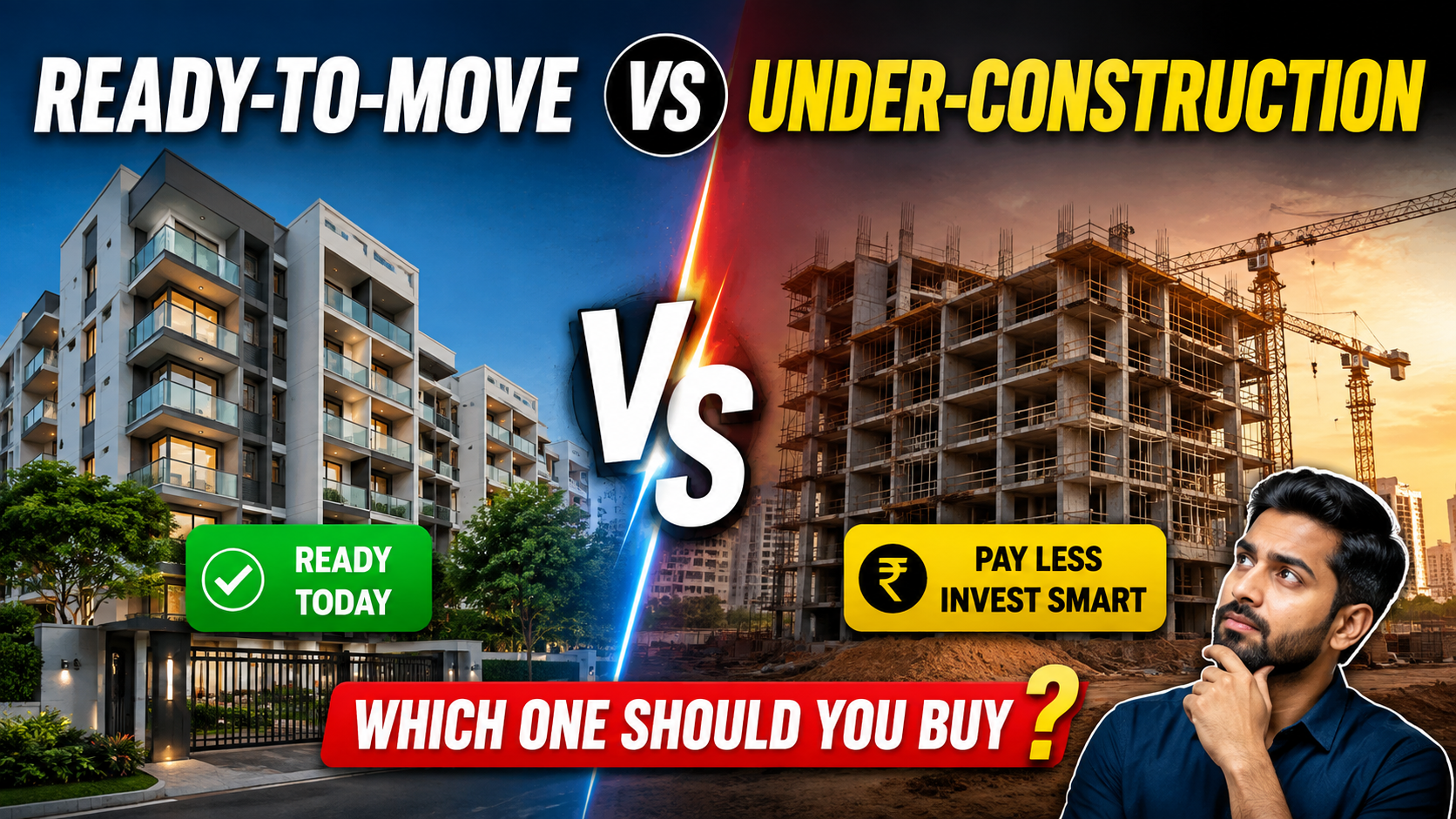
Buying a home can look simple from the outside. You find a property, compare the price, arrange a home loan, and plan the move.
Then you start comparing actual projects and the decision gets harder.
One apartment is ready to move in, so you can see the finished home today. Another is under construction, costs less at first glance, and gives you more choices of floors and layouts.
So which one should you buy?
The answer depends on your budget, how soon you need the house, your tolerance for waiting, and whether you’re buying for your family or as an investment. A ready-to-move property gives you much more certainty about what you’re purchasing. An under-construction property can give you more choice and a different payment timeline, but you also have to wait for completion.
Let’s compare both properly.
Table of Contents
Ready-to-move vs under-construction property
Before getting into the details, here’s the basic difference:
| Factor | Ready-to-move property | Under-construction property |
| Possession | Available after required formalities | Future possession |
| Property inspection | You can inspect the actual unit | Usually based on plans, specifications and construction progress |
| Waiting period | Usually short | Can be months or years |
| Construction uncertainty | Lower | Higher |
| Unit selection | Depends on available inventory | Often more choices at earlier stages |
| Rental potential | Can begin after possession | Usually starts after possession |
| Surrounding area | You can see it today | Some development may still be underway |
| Payment structure | Depends on seller/lender | May be linked to construction stages |
| Best suited for | Buyers who need a home soon | Buyers who can wait |
What is a ready-to-move property?
A ready-to-move property is a completed residential property that is available for possession after the applicable approvals and transaction formalities have been completed.
The biggest advantage is simple: you can see what you’re buying.
You can walk through the actual apartment. Check the rooms. Look at the view. Test the taps. Check the windows. See how much sunlight enters the home.
You can also inspect the building and the surrounding neighbourhood before making your decision.
For a first-time buyer, that can make the purchase easier to understand.
What is an under-construction property?
An under-construction property is still being developed when you purchase it.
Depending on when you buy, the project might be at the foundation stage, midway through construction, or close to completion.
Your decision is based on the approved plans, specifications, project layout, construction progress, agreement terms and information provided by the developer.
The waiting period can vary considerably.
That’s why you need to look beyond the sample apartment and sales brochure. The developer’s previous projects, project documents, approvals and actual construction progress deserve a close look.
First-Time Home Buyer Guide 15 Things to Check Before Buying a Property
1. Start with when you need the property
This is probably the easiest way to narrow down your decision.
Ask yourself:
When do I actually need to move in?
If you’re renting and need a home within the next few months, a ready-to-move property can make more sense.
You can complete the required purchase formalities and plan your move around the actual property.
An under-construction property can work better if you’re comfortable waiting.
For example, someone planning to move to Delhi NCR after 2 years may have plenty of time to consider an under-construction project. A family whose lease expires in 4 months has a very different situation.
Your timeline should be part of the property calculation from the beginning.
2. Compare the total cost
Don’t compare properties only by their advertised prices.
A property listed at ₹75 lakh doesn’t necessarily cost exactly ₹75 lakh by the time you own it.
Depending on the transaction, you may have to account for:
- Stamp duty
- Registration charges
- Parking
- Maintenance deposits
- Brokerage
- Loan-related charges
- Interiors
- Furniture
- Utility-related expenses
- Other charges mentioned in the agreement
Then consider the cost of waiting.
Suppose you’re paying ₹25,000 rent every month while waiting for an under-construction property.
A 24-month wait means:
₹25,000 × 24 = ₹6 lakh in rent
That doesn’t automatically make a ready-to-move property the better deal. It simply means your current rent belongs in the comparison.
Make a complete calculation before deciding.
3. Check how the home loan will affect you
A home loan can stay with you for 15, 20 or 30 years.
So don’t choose a property just because the first EMI looks manageable.
Look at:
- Loan amount
- Interest rate
- Loan tenure
- Processing charges
- Prepayment conditions
- Total interest payable
- Your existing EMIs
- Your monthly household expenses
For an under-construction property, loan disbursement may happen according to construction stages, depending on the lender and the terms of the transaction.
You may also continue paying rent while the property is being built.
That combination can put pressure on your monthly cash flow.
Before booking, ask your lender for a repayment calculation and check how the numbers look if interest rates change.
4. Research the developer
This matters especially when the building isn’t finished yet.
If you’re buying a ready property, you can inspect the completed structure. With an under-construction property, you’re also trusting the developer to complete the project according to the applicable commitments and approvals.
Look at the developer’s previous projects.
If possible, visit one.
Speak to residents. Ask about construction quality, maintenance, handover and common facilities.
Search for the developer’s project records through the relevant official authorities as well.
A polished sales office can tell you what the developer wants you to hear. A completed project tells you what the developer actually delivered.
5. Check RERA information
If the project falls under the Real Estate (Regulation and Development) Act, 2016, check its registration with the appropriate state or Union Territory RERA authority.
Don’t rely only on the registration number printed in a brochure.
Look up the project through the official authority and compare the information with what the developer has provided.
Depending on the project and available records, you may find information about:
- Promoter details
- Project registration
- Land and title information
- Encumbrances
- Approved plans
- Project timelines
- Construction progress
- Other project disclosures
- Complaints or regulatory information
This check is particularly useful when you’re considering an under-construction project.
For Delhi NCR, remember that the applicable authority depends on where the property is located. Delhi, Haryana and Uttar Pradesh have separate regulatory systems.
6. Inspect the actual property
This is where ready-to-move homes have a big advantage.
You can inspect the exact apartment you’re planning to purchase.
Don’t just walk around for 10 minutes with the salesperson.
Turn on the taps.
Check the water pressure.
Open the windows.
Test electrical switches.
Look at the flooring.
Check bathroom drainage.
Inspect the walls for dampness, cracks or visible defects.
Stand on the balcony and listen to the surroundings.
Then look outside.
Is another building blocking the sunlight?
Is the road noisy?
Does the apartment have enough ventilation?
These details are much easier to judge when you’re standing inside the finished property.
For an under-construction home, you’ll need to rely more heavily on the approved plans, specifications, agreement and construction progress.
7. Visit the location more than once
A locality can feel completely different at different times.
Visit during the morning rush.
Visit in the evening.
If possible, visit on a weekend too.
Check:
- Traffic
- Parking
- Public transport
- Road conditions
- Street lighting
- Nearby shops
- Schools
- Hospitals
- Noise
- Waterlogging
- Ongoing construction
Talk to residents living nearby.
A salesperson might tell you that a metro station is “very close.” A resident can tell you what the actual walk feels like at 8 AM.
That difference matters when you’re going to live there for years.
8. Compare carpet area, not just the advertised size
Property advertisements can make size comparisons confusing.
One project may advertise a super built-up area while another focuses on carpet area.
Ask for the carpet area and study the floor plan carefully.
Then think about how you’ll use the space.
Can your furniture fit?
Is there enough storage?
Is the kitchen practical?
Can you comfortably place a dining table?
Are the bedrooms large enough for your needs?
A bigger number on the brochure doesn’t automatically mean a better home.
The layout matters just as much as the total area.
9. Consider your choice of floor and unit
Under-construction projects can give early buyers more choices.
Depending on the project’s inventory, you may be able to choose between different:
- Floors
- Views
- Layouts
- Unit sizes
- Towers
- Directions
- Parking options
A ready project may have fewer units available.
But don’t pay a huge premium simply because someone tells you a particular floor is “the best.”
Think about your actual needs.
If your parents will live with you, easy access may matter more than being on the highest floor.
If you work from home, natural light and a quiet room may matter more than having a large clubhouse.
Choose the property around your life.
10. Understand possession risk
This is one of the biggest differences between the 2 options.
A completed property has already passed through the major construction phase.
An under-construction property still has to reach completion.
A delay can affect your:
- Rent
- Loan costs
- Moving plans
- School arrangements
- Commute
- Furniture purchases
- Family plans
Read the possession terms in the agreement carefully.
Check the expected possession date and understand what the agreement says about delays and the remedies available to the buyer under the applicable law.
Don’t make your financial plans around a verbal statement such as “possession will be next month.”
The written documents matter.
11. Look at the surrounding development
A ready property lets you see the neighbourhood as it exists today.
An under-construction project can be different.
You might have an empty plot beside the property today. That plot could later become another residential building, commercial development or infrastructure project.
Check publicly available information about major planned development around the property where possible.
Also think about your daily commute.
A beautiful apartment isn’t very useful to you if getting to work takes 90 minutes each way and you’re doing that 5 days a week.
Location should be judged by your daily routine, not just the pin on Google Maps.
12. Check rental potential if you’re buying as an investment
If you’re purchasing the property as an investment, the calculation changes.
A ready property can potentially generate rent after possession and the required formalities.
An under-construction property usually won’t produce rental income while it’s still being built.
Compare:
Purchase price + buying costs + holding costs
against:
Expected rent + possible appreciation + resale prospects
Don’t assume a new project will automatically give better returns.
Check actual rental demand in the area.
Look at comparable properties.
See what tenants are paying for similar apartments.
A property near employment centres, transport links, universities or established commercial areas may have stronger rental demand than a similarly priced property in a poorly connected location.
13. Understand maintenance costs
Modern residential projects can have gyms, clubhouses, swimming pools, gardens, security systems and multiple lifts.
All of those facilities cost money to operate.
Ask about the maintenance charges before you buy.
For a ready property, speak to existing residents and find out what they’re actually paying.
For an under-construction project, ask for the expected maintenance structure and check the relevant documents.
Look for:
- Monthly maintenance
- Parking charges
- Club charges
- Corpus contributions
- Water charges
- Common electricity
- Security costs
- Other recurring expenses
A ₹5,000 monthly maintenance bill is ₹60,000 every year.
That’s worth including in your long-term budget.
14. Read the sale agreement carefully
Don’t rush through the agreement because you’ve already decided that you want the property.
Read the clauses covering:
- Total purchase price
- Payment schedule
- Carpet area
- Possession
- Delays
- Cancellation
- Parking
- Maintenance
- Specifications
- Defects
- Registration
- Buyer obligations
- Developer or seller obligations
If you don’t understand a clause, ask a qualified property lawyer.
A legal review can cost relatively little compared with the financial consequences of signing an agreement you don’t fully understand.
And if a salesperson says the offer is valid only for a few hours, don’t let that pressure you into skipping document checks.
15. Think about your plans 5 years from now
A property is a long-term purchase.
Ask yourself:
Will your family grow?
Will you still work in the same area?
Will the commute remain manageable?
Will you need another bedroom?
Will your parents be comfortable there?
Can you afford the maintenance?
Could you rent the property later if your circumstances change?
You don’t need to predict your entire future.
Just make sure the property doesn’t create an obvious problem for the life you’re already planning.
Ready-to-move property: advantages and drawbacks
Why buyers choose ready-to-move homes
You can see the actual property.
You know the layout, finishing, view and surrounding environment.
You can move sooner.
Once the required purchase and possession formalities are completed, you can plan your move without waiting for construction.
You can inspect the building.
You can check common areas, lifts, parking, water supply and other facilities.
Rental income can start sooner.
This can matter if you’re purchasing for investment.
Things to consider
A ready property may have a higher purchase price compared with an early-stage project.
You may also have fewer options regarding floor, view and layout.
And if the property is several years old, you’ll need to inspect it carefully for maintenance and repair issues.
Under-construction property: advantages and drawbacks
Why buyers consider under-construction homes
You may have more unit choices.
Early buyers can sometimes select their preferred floor, layout or tower.
The building will be newer when completed.
You may be moving into a newly completed project with new facilities and infrastructure.
Payments may be spread over construction stages.
The exact structure depends on the developer, lender and agreement.
You can buy into a developing locality.
If the surrounding area is improving, future infrastructure and services may affect the property’s appeal.
Things to consider
You have to wait for possession.
Construction delays can affect your finances and plans.
The final surroundings may differ from what you see when you book the property.
And you have less ability to inspect the finished apartment at the time of purchase.
A simple cost example
Let’s say you’re comparing:
Ready-to-move property: ₹80 lakh
Under-construction property: ₹72 lakh
The under-construction option looks ₹8 lakh cheaper.
But suppose possession is expected after 2 years and you’re paying ₹25,000 rent every month.
Your rent during that period would be:
₹25,000 × 24 months = ₹6 lakh
Now the initial ₹8 lakh difference has effectively reduced to ₹2 lakh before considering the other costs associated with the purchase.
The example doesn’t prove that the ready property is better.
It shows why the complete cost matters.
You need to include rent, loan costs, registration, interiors, maintenance and the expected possession timeline before comparing the 2 properties.
Which one should you buy?
A ready-to-move property can be the better choice if you need a home soon, want to inspect the actual apartment and prefer knowing exactly what the building and neighbourhood look like before purchasing.
An under-construction property can make sense if you’re comfortable waiting, you’ve checked the developer’s record, the project documentation is in order, construction is progressing properly and the financial calculation works for you.
There isn’t one option that’s right for every buyer.
Your budget and timeline should decide more than the sales pitch.
Before paying a booking amount, check the documents, verify the project information, inspect the location, calculate the full cost and read the agreement carefully.
Then make your decision.
Disclaimer: This article is for general educational purposes and isn’t legal, financial or tax advice. Property laws, RERA requirements, taxes, registration charges and lending rules can vary by state and individual circumstances. Verify current requirements with the relevant government authority and consult a qualified property lawyer or financial professional before making a property purchase in India.
What is the main difference between a ready-to-move and an under-construction property?
A ready-to-move property is already completed and can generally be occupied after completing the required purchase formalities. An under-construction property is still being developed, so the buyer may need to wait until construction and possession are completed.
What should I check before buying an under-construction property?
Buyers should check the developer’s track record, project approvals, RERA registration where applicable, construction progress, payment schedule, possession timeline, total purchase cost, and the property’s location and future demand. Comparing these factors with a ready-to-move property can help make a more informed decision.
Pingback: How to calculate rental yield before buying an investment property - SM Villa
Pingback: Property investment mistakes that can cost buyers lakhs of rupees
Pingback: Residential vs commercial property: which is better for investment? - SM Villa
Pingback: Property Day Checklist: What to inspect in india 2030 - SM Villa