
Buying a house is exciting until the paperwork lands on your table.
You might have found the right location, liked the floor plan and agreed on the price. Then someone hands you a folder full of sale deeds, tax receipts, approvals and legal papers.
Take your time here.
A property can look perfect during a site visit and still have an ownership dispute, an unpaid loan or an approval problem sitting inside the paperwork. That’s why document checking should happen before you pay a large amount or sign the final agreement.
If you’re buying a flat in Delhi, a house in Rohini, a villa in Gurgaon or a plot elsewhere in India, the exact documents can differ. The basic checks are fairly similar.
Table of Contents
Start with the title deed
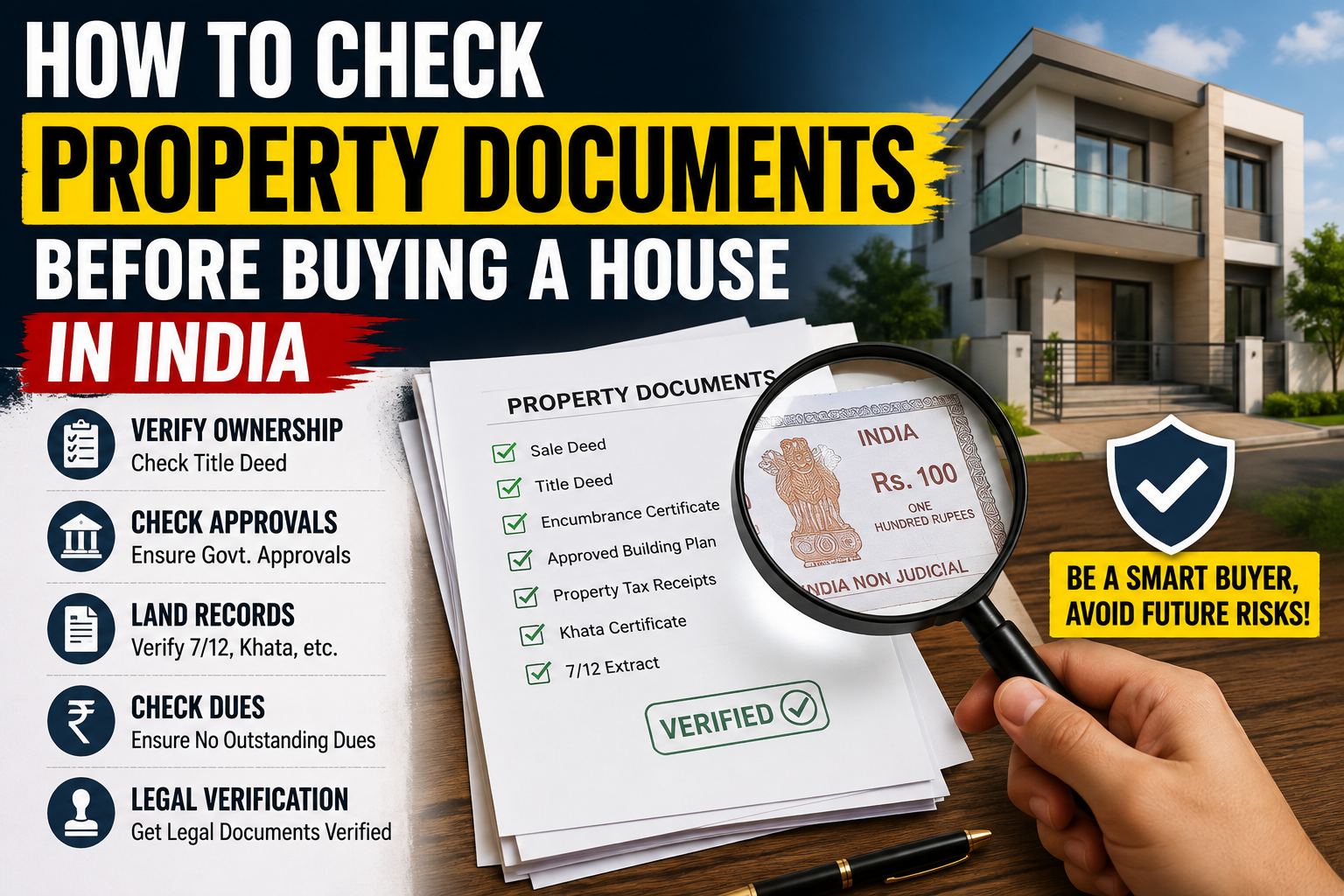
The title deed is one of the first documents you should ask to see.
It helps establish who owns the property and how that ownership was created or transferred.
Check the owner’s name, property address, area, property number and other details. They should match the property you’re actually planning to buy.
If you’re buying an apartment, compare the flat number, floor, tower and carpet area with the information in the documents.
For a plot or independent house, land details deserve extra attention.
A property lawyer should examine the title and tell you whether the seller has a valid right to transfer the property to you.
Check the previous sale deeds
The current owner’s document tells you who owns the property today. You also need to understand how that person became the owner.
Suppose the property has changed hands 3 times.
Owner A sold it to Owner B. Owner B sold it to Owner C. Owner C is now selling it to you.
The documents connecting those transactions form the ownership history.
Ask for the previous sale deeds, conveyance documents and other relevant papers. Your lawyer can check whether the ownership chain is complete and whether any gaps need attention.
If an old document is missing, ask why.
Don’t brush it aside because the current owner seems trustworthy. Paperwork should answer the question before money changes hands.
Ready to move in vs the under construction?
Check the encumbrance certificate
An Encumbrance Certificate, commonly called an EC, can help you check registered transactions and certain recorded claims connected with a property for a particular period.
Depending on the state, the EC can contain information about registered mortgages and other registered transactions.
The format and process vary across India.
Ask for the relevant EC and verify it through the appropriate authority where that service is available. Your lawyer can also tell you what period should be checked.
An EC is one part of the legal check. It shouldn’t be treated as the only proof that a property has no possible dispute or claim.
Find out if there’s an existing loan
This is a check you should take seriously.
Ask the seller whether the property has an existing home loan or another charge attached to it.
If a bank has financed the property and the loan hasn’t been cleared, the lender may have rights over the property.
A sale can still happen in some situations, but the outstanding loan needs to be handled properly.
Ask for the relevant loan documents and details of the outstanding amount. If the seller says the loan has already been paid off, ask for proof of closure and the relevant release documents.
Don’t build your purchase around a sentence like, “I’ll clear the loan after you pay me.”
Get the arrangement documented and have your lawyer and lender check the transaction structure.
Verify the seller’s identity
The person selling the property should have the legal authority to sell it.
Compare the seller’s identity with the name appearing on the title documents.
Pay attention when there are multiple owners.
If 2 people jointly own the property, check whether both need to participate in the sale. The same care applies to inherited properties, company-owned properties, trust-owned properties and transactions involving a Power of Attorney.
The person standing in front of you isn’t enough proof of ownership.
The documents have to support the claim.
Look closely at inherited property
Inherited properties need extra checking because several family members can have rights in the same property.
Suppose a house belonged to someone’s father and he passed away. His son is now trying to sell the house.
You need to know how the property passed to the son and whether other heirs have any rights.
Depending on the circumstances, the paperwork can include:
- Death certificate
- Will, where applicable
- Legal heir or succession records
- Probate documents, where required
- Relinquishment deeds
- Partition documents
- Previous title documents
The exact requirements depend on the family situation and applicable law.
If several heirs are involved, get a lawyer to establish who needs to sign or participate in the transaction.
This is one place where saving a little money on legal advice can become an expensive mistake later.
Check mutation and revenue records
Mutation records relate to updating relevant government or revenue records after a change in ownership or possession.
The process and terminology vary between states.
These records can provide useful information about the property and its recorded holder, especially when you’re buying land, a plot or an independent house.
Ask your lawyer which revenue records apply to the property you’re considering.
Then compare the owner’s name, land details and other information with the title documents.
The records should tell a consistent story.
Check the approved building plan
Buying a house means checking the construction as well as the land.
Ask for the approved building plan where applicable.
This matters particularly for independent houses, builder floors, villas and properties where additional construction has been carried out.
Look at what’s actually built.
Then compare it with the approved plan.
For example, a property might have approval for 2 floors while a third floor was added later without the required permission. That’s something you want to discover before buying the house.
Unauthorised construction can create problems with authorities and can also affect future resale or financing.
Get the plan checked by someone who understands local building rules.
Check completion and occupancy documents
For a completed building, ask for the applicable completion and occupancy-related documents issued by the competent authority.
The exact document and approval requirements depend on the location, local authority and type of property.
These records can help establish whether the building was completed according to the applicable requirements and whether occupation is permitted.
Don’t assume everything is fine simply because other families already live in the building.
Ask for the documents.
Then have them reviewed.
Check RERA information
If you’re buying a project covered by RERA, check its registration with the relevant state or Union Territory RERA authority.
Use the official authority’s website and search for the project yourself.
Then compare the information with what the developer has given you.
Depending on the project, you may find information about:
- Promoter details
- Project registration
- Land information
- Encumbrances
- Approved plans
- Construction status
- Project timelines
- Regulatory records
- Complaints, where available
This check is particularly useful when you’re buying an under-construction property.
If you’re looking at Delhi NCR, remember that Delhi, Haryana and Uttar Pradesh have separate authorities. Check the authority that applies to the property’s actual location.
Check who owns the land
An apartment developer isn’t always the owner of the land underneath the project.
Sometimes the land belongs to one party while another party has development rights.
That’s why you should understand the legal relationship between the landowner and developer.
Ask for the relevant title documents and development agreement or other documents that establish the developer’s rights.
Your lawyer should check whether the developer has the legal authority to construct and sell units in the project.
This becomes particularly important when you’re buying an apartment in a large development.
Check property tax records
Ask the seller for recent property tax receipts.
You want to know whether taxes have been paid and whether any amount remains outstanding.
Also ask about other pending payments, such as:
- Electricity bills
- Water charges
- Society maintenance
- Municipal dues
- Other local charges
If you’re buying an apartment, speak with the society or association and ask whether the seller has unpaid maintenance.
Your sale agreement should make it clear who is responsible for dues up to the relevant date.
You don’t want an old bill appearing after you’ve taken possession.
Check housing society records
If you’re buying a flat in a society, the society office can tell you things that the seller’s paperwork might not show clearly.
Ask about pending maintenance.
Ask about parking.
Ask about any major repair work planned for the building.
Check the society’s transfer requirements and rules.
And be careful with things like parking spaces, terraces and storage areas.
If someone says, “This parking is yours,” ask where that right appears in the documents.
A verbal promise isn’t something you want to build a ₹70 lakh or ₹1 crore purchase around.
Check the property area
Property advertisements can make area comparisons confusing.
You might see:
- Carpet area
- Built-up area
- Super built-up area
- Plot area
- Land area
For an apartment, ask for the carpet area and floor plan.
Then check whether the area mentioned in the agreement matches the relevant property documents.
If one document says 1,200 sq. ft. and another says 1,350 sq. ft., ask for an explanation.
There might be a legitimate reason for the difference. Different measurements can refer to different parts of the property.
Still, get it explained before signing.
Check the sale agreement carefully
The sale agreement deserves your full attention.
Read the sections covering:
- Property details
- Purchase price
- Payment schedule
- Possession
- Registration
- Taxes
- Other charges
- Parking
- Maintenance
- Cancellation
- Default
- Seller responsibilities
- Buyer responsibilities
Don’t sign a document you haven’t understood.
If a clause seems confusing, ask your lawyer to explain it in plain language.
And don’t let a salesperson rush you because “the offer expires today.”
A property transaction involves too much money for rushed paperwork.
Be careful with Power of Attorney transactions
A Power of Attorney can allow someone to act on another person’s behalf.
That doesn’t automatically make the person holding the POA the owner.
If you’re dealing with a POA transaction, ask your lawyer to check:
- Who owns the property
- Who issued the POA
- Whether the POA is valid
- What powers it gives
- Whether it allows the proposed sale
- Whether other documents are required
The legal effect of a POA depends on its wording and the circumstances of the transaction.
Get it checked before paying a substantial amount.
Check land-use restrictions
Land can have restrictions on how it is used or transferred.
This matters especially when you’re buying a plot, agricultural land or an independent house.
Depending on the property, you may need to check:
- Land use
- Leasehold rights
- Government allotment conditions
- Agricultural land restrictions
- Local zoning
- Development permissions
- Authority approvals
A property can physically look like a normal residential plot while having restrictions in its records.
Ask a local property lawyer which records apply to that particular property.
Compare every document with the others
This is where your checking gets interesting.
Don’t read each document separately and move on.
Compare them.
Look at the seller’s name across the title deed, previous sale deed, tax records and other relevant documents.
Check the property number.
Check the area.
Check the address.
Check the flat number.
Check the land details.
If something doesn’t match, ask about it.
For example, if the current owner’s name is spelled differently on 2 documents, it might be a simple clerical issue. Or it might need formal correction.
You won’t know until you ask.
Get a property lawyer involved
You can collect documents yourself.
You can download RERA records yourself.
You can check tax receipts yourself.
But a property lawyer can put the pieces together.
A proper legal review can examine:
- Current ownership
- Previous ownership
- Title history
- Registered encumbrances
- Existing loans
- Court matters
- Land records
- Building approvals
- Development rights
- Sale agreement
- Local requirements
If you’re spending ₹50 lakh, ₹80 lakh or ₹1 crore on a house, legal review should be part of your purchase budget.
It can save you from a much bigger bill later.
Property document checklist
Keep this list open when you’re checking a property.
| Document or check | What you should check |
| Title deed | Current owner’s legal title |
| Previous sale deeds | Ownership history |
| Encumbrance Certificate | Registered transactions and encumbrances |
| Loan documents | Existing mortgage or lender claim |
| Seller identity | Owner’s identity and authority |
| Mutation records | Relevant recorded ownership details |
| Revenue records | Land and property information |
| Approved building plan | Permitted construction |
| Completion documents | Applicable completion approval |
| Occupancy-related approval | Permission for occupation, where applicable |
| RERA registration | Project details, where applicable |
| Property tax receipts | Pending tax |
| Society records | Maintenance and other dues |
| Development documents | Developer’s rights |
| Sale agreement | Terms of your purchase |
| Power of Attorney | Authority to sell, where applicable |
Red flags you should take seriously
Slow down if you see any of these:
- The seller refuses to provide important documents.
- Original documents aren’t available and there’s no clear reason.
- Names don’t match across records.
- Property measurements keep changing.
- There’s a gap in the ownership history.
- An existing loan isn’t clearly disclosed.
- The seller mentions a dispute but won’t provide details.
- The actual construction looks different from the approved plan.
- The developer can’t provide project records.
- You’re being pushed to transfer a large amount immediately.
- The property price is far below similar properties without a clear reason.
One strange document doesn’t automatically mean the property is bad.
It means you need an explanation before you continue.
A practical document-checking process
You can keep the process simple.
1. Collect the documents
Ask the seller or developer for the ownership, approval, tax, project and transaction documents relevant to the property.
2. Compare the details
Check names, property numbers, measurements, addresses and ownership history.
3. Verify official records
Check the relevant registration, revenue, municipal and RERA records for the property.
4. Get legal review
Give the full document set to a qualified property lawyer.
5. Complete the transaction
Once the documents and agreement have been checked, proceed with payment and registration according to the legal advice you receive.
The safest time to find a property problem
Before you buy it.
That’s the whole point of checking property documents.
You don’t need to become a property lawyer yourself. You do need to ask the right questions, collect the paperwork and give a qualified lawyer enough time to check it properly.
Check the title.
Trace the ownership history.
Look for loans and registered encumbrances.
Check the construction approvals.
Verify taxes and society dues.
If it’s a project covered by RERA, check its official records.
Then read the agreement before signing it.
A 2-hour site visit tells you what the house looks like.
The documents tell you what you’re actually buying.
Disclaimer: This article is for general educational purposes and doesn’t constitute legal, financial or tax advice. Property laws, registration procedures, land records, RERA requirements, taxes and approval processes can vary by state, local authority and property type. Verify current requirements with the relevant government authority and consult a qualified property lawyer before purchasing a property in India.
FAQ
Which property documents should I check before buying a house in India?
Important documents may include the title deed, sale deed, encumbrance certificate, approved building plan, property tax receipts, land or municipal records, and relevant possession or completion documents. The exact documents can vary depending on the property type and state.
Should I get property documents legally verified before buying?
Yes. It is advisable to have the property’s ownership, title, approvals, outstanding dues, and other relevant records reviewed by a qualified property lawyer before signing the agreement or making a major payment. This can help identify potential ownership disputes, unpaid liabilities, or documentation issues before the purchase.
Pingback: Residential vs commercial property: which is better for investment? - SM Villa
Pingback: How to calculate rental yield before buying an investment property - SM Villa
Pingback: Flat vs Independent House vs Villa: Which Property Is Right for Your Family? - SM Villa
Pingback: How AI Is Changing the Way People Search for Homes in 2026