
Buying a home in India involves more than the property price. Stamp duty and registration charges can add a significant amount to your total cost, so knowing how these charges work can help you plan your budget before signing the deal.
You find a flat for ₹60 lakh.
You arrange the down payment.
The bank approves the loan.
Everything looks fine.
Then someone tells you that the property will cost more than ₹60 lakh because you also have to pay stamp duty and registration charges.
This catches first-time buyers off guard all the time.
The listed property price is only one part of the purchase cost.
When you’re planning your home budget, stamp duty and registration charges deserve their own line on the spreadsheet.
What is stamp duty?
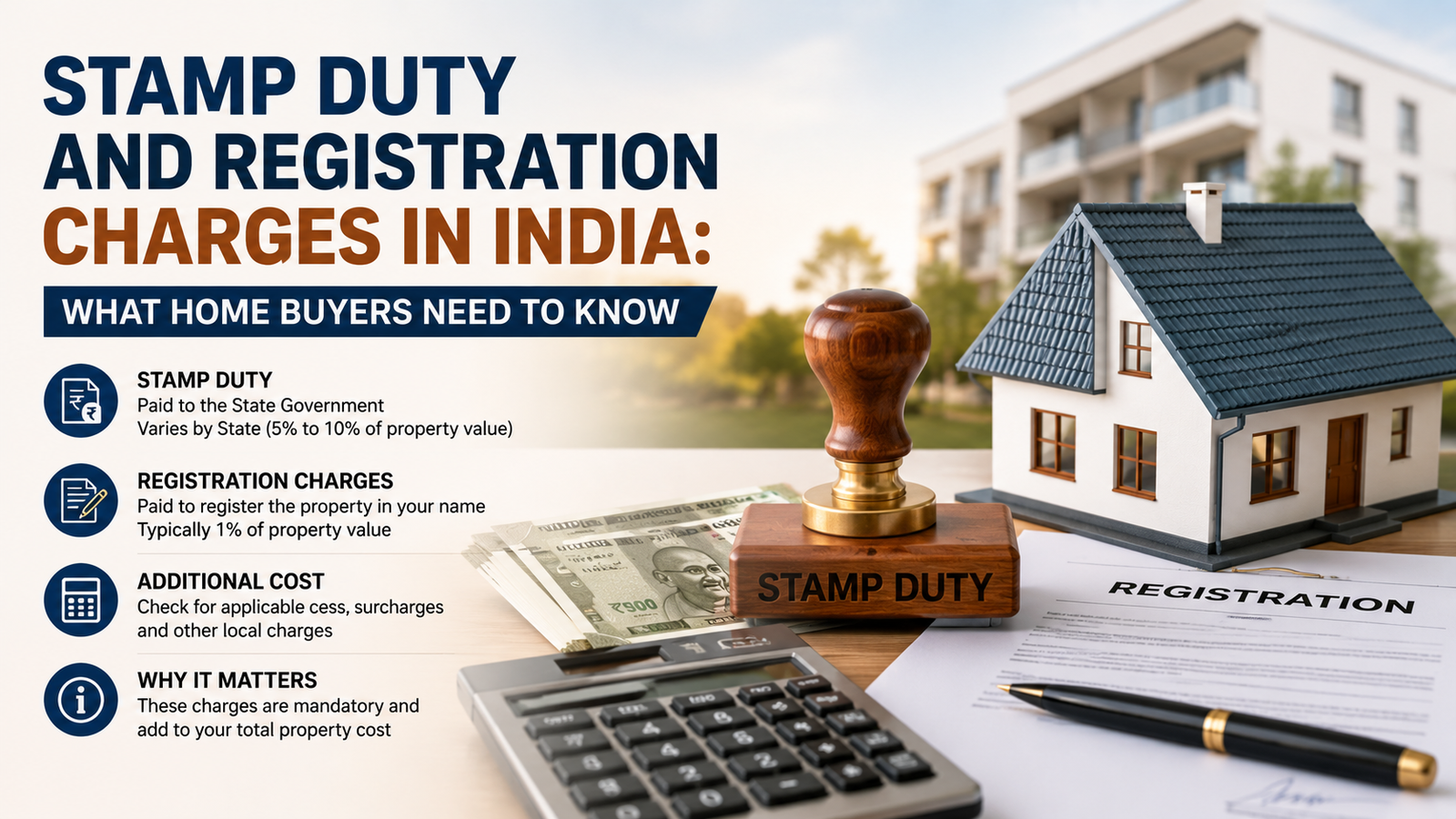
Stamp duty is a government tax charged on certain legal instruments and transactions, including property transactions.For a home buyer, the amount is generally calculated according to the applicable stamp duty rules of the state or Union Territory where the property is located.
The rate can vary.
And so can the method used to determine the value on which the duty is charged.
This is why you shouldn’t assume that a friend in another city paid the same percentage.
Their property may be in a different state.
What is property registration?
Registration is the process of recording the property transaction with the appropriate government registration authority.
When you buy a property, the sale deed or other applicable document needs to be registered according to the law.
Registration creates an official record of the transaction.
For many buyers, this is the moment when the purchase starts to feel very real.
You have paid the agreed consideration.
You have paid the applicable government charges.
You sign and register the document.
The property transaction is formally recorded.
Latest Blog – Rera and how does it protect property
Stamp duty and registration are different
People often use the terms together.
They’re related, but they’re not the same thing.
Stamp duty is a tax charged on the relevant instrument or transaction.
Registration charges are fees associated with registering the document.
Both can add a significant amount to your purchase cost.
Suppose you’re buying a ₹70 lakh property.
Even a few percentage points can mean several lakh rupees.
That’s money you need to have available.
How much are stamp duty and registration charges?
There isn’t one single rate for all of India.
The applicable charges depend on factors such as:
- State or Union Territory
- Property type
- Property location
- Transaction value
- Government valuation
- Buyer category in some jurisdictions
- Type of instrument
- Applicable concessions or exemptions
Some states provide different rates for women buyers or specific categories.
Some jurisdictions use guidance values, circle rates, ready reckoner rates, collector rates, or similar government valuation systems.
The terminology differs.
The calculation can also change.
So before budgeting, check the current government rates applicable to your exact property.
Why does the government use a property value?
Suppose you agree to buy a property for ₹50 lakh.
But the government valuation used for stamp duty purposes is ₹60 lakh.
Depending on the applicable state rules, duty may be calculated using the prescribed higher value or the applicable method.
That’s why simply multiplying the negotiated price by a percentage can produce the wrong estimate.
Ask the registration office, authorised service provider, or property lawyer how the charge will be calculated.
What is circle rate?
You may hear the term circle rate when buying property in India.
Circle rate is a government-determined value used in property transactions for various purposes, including calculation of stamp duty and registration-related charges in many jurisdictions.
Different states use different terminology.
Delhi, for example, has its own circle rate framework.
Other states may use terms such as guidance value or ready reckoner rate.
The basic idea is similar: the government has a prescribed valuation framework, and your transaction isn’t always assessed solely on the price written in your negotiation.
Example: buying a ₹60 lakh flat
Suppose you’re buying a flat for ₹60 lakh.
You budget ₹12 lakh as your down payment and expect the bank to finance the rest.
Then you calculate your expenses.
Assume, purely for illustration, that applicable government charges together work out to several percentage points of the relevant value.
If the effective additional cost were 7%, that would be:
₹60,00,000 × 7% = ₹4,20,000
Now your cash requirement isn’t ₹12 lakh.
It’s potentially ₹16.2 lakh before considering other expenses.
The 7% figure here is only an example. Your actual rate may be completely different depending on the state and transaction.
Always use the current official rate for your property.
Can stamp duty be included in a home loan?
This depends on the lender and the structure of your loan.
In many cases, banks calculate the home loan based primarily on the property’s eligible value and loan-to-value limits, while stamp duty and registration charges may need to be paid separately by the buyer.
That means you shouldn’t assume the bank will finance every rupee you need to complete the purchase.
Ask your lender before finalising your budget.
The question to ask is simple:
“How much cash will I need from my side, including stamp duty and registration?”
Get the answer in writing.
Don’t forget other purchase costs
Stamp duty and registration are only part of the extra costs.
Depending on the transaction, you may also have:
- Brokerage
- Legal fees
- Loan processing fees
- Valuation fees
- Documentation charges
- Society or association charges
- Maintenance deposits
- Utility connection charges
- Parking charges
- Interior work
- Moving expenses
- Insurance
- Taxes where applicable
Some are paid once.
Some continue every month.
And some appear after possession.
Your budget should account for them before you sign the agreement.
Who pays stamp duty?
Usually, the buyer pays stamp duty and registration-related charges in a typical property purchase, although the exact legal responsibility can depend on the document and applicable state law.
Don’t rely on a casual statement from a broker.
Check the agreement and applicable rules.
Are rates different for men and women?
In some Indian states, women buyers receive concessions in stamp duty or registration charges.
The rules vary by state.
There can also be conditions around ownership structure and eligibility.
If you’re considering buying property in the name of a woman family member to receive a concession, understand the legal and financial consequences first.
Ownership isn’t something you should change purely to save a few thousand rupees without understanding the bigger picture.
What happens if the property is jointly owned?
Suppose a husband and wife buy a property together.
The applicable stamp duty treatment can depend on the state and how the ownership and document are structured.
Some states provide specific concessions.
Others don’t.
Ask the registration authority or a qualified property lawyer before executing the document.
Stamp duty on ready-to-move properties
For a completed property, the registration process usually involves the sale deed or other applicable conveyance document.
The charges depend on the applicable government rules and property value.
Make sure the agreement amount, payment details, property description, and other information are accurate.
A small spelling mistake in a name is annoying.
A wrong property description can create a much bigger problem.
Stamp duty for under-construction properties
Under-construction transactions can involve different documents and payment stages.
The applicable stamp duty treatment can depend on the nature of the agreement and state law.
Don’t assume that the calculation is identical to a completed property purchase.
Ask your lawyer to review the agreement before signing.
What is an agreement for sale?
An agreement for sale records the terms under which the seller or promoter agrees to sell the property to the buyer.
It can cover:
- Property details
- Purchase price
- Payment schedule
- Possession
- Default
- Cancellation
- Construction specifications
- Parking
- Amenities
- Other obligations
Read this document carefully.
The sales brochure is marketing material.
The agreement is the document that sets out contractual obligations.
Why buyers should calculate total acquisition cost
Imagine 2 properties.
Property A costs ₹70 lakh.
Property B costs ₹74 lakh.
You might immediately choose Property A.
But suppose Property A requires higher parking charges, larger maintenance deposits, and more interior work.
Property B includes some items that Property A doesn’t.
The cheaper sticker price may not produce the cheaper purchase.
Calculate the full cost.
A simple property cost sheet
Before booking, create these rows:
Property price: ₹70,00,000
Stamp duty: Check state rate
Registration: Check applicable fee
GST, where applicable: Verify based on property type and transaction stage
Brokerage: ₹____
Legal review: ₹____
Loan charges: ₹____
Maintenance deposit: ₹____
Parking: ₹____
Interiors: ₹____
Moving: ₹____
Then add everything.
This gives you a more realistic cash requirement.
When should you pay stamp duty?
The timing depends on the document, state rules, and transaction structure.
In many property transactions, stamp duty must be paid before or at the time of execution or registration of the relevant instrument.
Don’t wait until the registration appointment to ask.
Your lawyer, registration office, bank, or authorised service provider can confirm the exact process.
What if the seller asks you to show a lower property price?
Be very careful.
Someone might say:
“Registry ₹50 lakh ki karwa do, baaki cash mein de dena.”
This can create serious legal and financial problems.
Never agree to understate the transaction value simply because someone says it’s normal.
You should record the genuine transaction and follow applicable tax and registration laws.
Saving money on duty isn’t worth creating a documentation problem around a property worth tens of lakhs.
What documents are needed for registration?
The exact list varies by state and transaction.
Common documents can include:
- Sale deed or relevant instrument
- Agreement for sale
- Identity documents
- PAN
- Address proof
- Photographs where required
- Proof of payment
- Property documents
- Stamp duty payment details
- Registration fee details
If there is a home loan, the bank may have its own documentation requirements.
Check the latest list before your appointment.
Can stamp duty rates change?
Yes.
Government rates and policies can change.
That means an estimate you found in an old YouTube video from 2023 might not be accurate for your 2026 purchase.
Use current official information.
This matters even more when you’re buying an expensive property.
A 1% difference on ₹1 crore is ₹1 lakh.
What should first-time buyers do?
Start with the property price.
Then calculate the government charges.
Then add transaction costs.
Then add your expected interior and moving budget.
Finally, calculate how much cash you need before possession.
If you have ₹15 lakh saved and the transaction requires ₹18 lakh from your side, you’ll have a problem even if the EMI looks affordable.
The upfront cash requirement matters.
Final thought
Stamp duty and registration charges aren’t exciting.
Nobody visits a showroom and gets excited about government fees.
But they can add several lakh rupees to a property purchase.
So calculate them before you book.
Check the current state rules, confirm the valuation method, ask your lender how much you’ll need to contribute, and keep a separate cash buffer for the costs that appear around registration and possession.
Your home budget should include the money required to actually complete the purchase.
FAQs
1. Are stamp duty and registration charges the same?
No. Stamp duty is a tax on the applicable instrument or transaction, while registration charges are fees associated with registering the document.
2. Does stamp duty have the same rate across India?
No. Rates and calculation methods vary by state or Union Territory and can depend on the property and transaction.
3. Can I avoid stamp duty by showing a lower property price?
You shouldn’t understate the genuine transaction value to reduce government charges. Follow the applicable registration and tax rules.
4. Should I include stamp duty in my home-buying budget?
Yes. Calculate stamp duty and registration charges before deciding how much cash you need for the purchase.
Pingback: Home loan EMI vs rent: When does buying a house make financial sense?
Pingback: Buying vs Renting in India vs Dubai: Where Does Your Money Go Further in 2026?
Pingback: Property Day Checklist: What to inspect before you accept the keys - SM Villa
Pingback: Top 50 countries with the highest homeownership rates in the world