
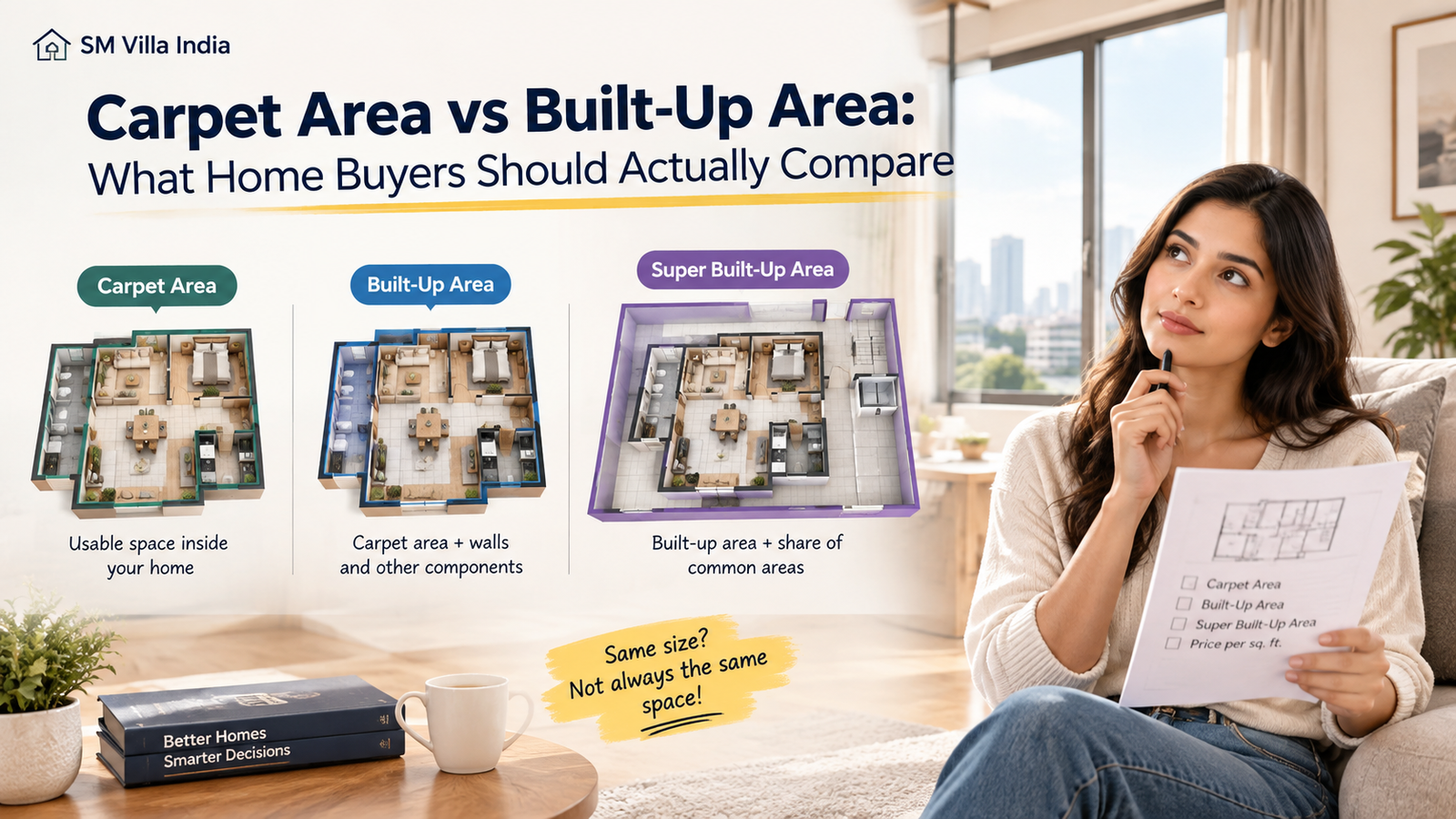
When buying a home, the number of square feet shown in an advertisement can be a little misleading if you don’t know what that number actually represents. Carpet area and built-up area are not the same thing, and the difference can affect how much usable space you get for your money. Before comparing two flats, it’s important to understand these measurements and look beyond the headline size.
Table of Contents
You find a flat advertised as 1,500 sq. ft. Another flat nearby is also advertised as 1,500 sq. ft. The prices look similar. The bedrooms are similar. The floor plans look almost the same. So you assume both homes give you roughly the same amount of space. Then you visit them. One apartment feels noticeably larger. The other feels tighter.
That confusion usually starts with one simple problem: the 1,500 sq. ft. number on the property advertisement may not mean the same thing you think it means.
When you’re buying a flat in India, you’ll come across terms such as carpet area, built-up area and super built-up area. Sellers and developers can use these measurements in different parts of the buying process, and that can make comparing properties surprisingly difficult.
For a buyer, carpet area deserves special attention because it gives you a much clearer picture of the area inside the apartment.
And once you understand the difference, property comparisons become much easier.
What is carpet area?
Carpet area refers to the usable floor area inside an apartment, subject to the definition applicable under RERA.
Under the Real Estate (Regulation and Development) Act, 2016, carpet area is defined around the net usable floor area of the apartment, with specific exclusions such as areas covered by external walls, service shafts, exclusive balconies or verandahs and exclusive open terraces. The Act also provides for carpet area to be disclosed for apartments in registered projects.
The easiest way to think about it is this:
Two Identical Flats in the same society
Carpet area is much closer to the space you can actually use inside your flat.
Your living room counts.
Your bedroom counts.
Your kitchen counts.
Your bathroom counts.
Internal areas that fall within the applicable definition count too.
An external wall doesn’t suddenly become usable living space because a brochure includes it in a larger area calculation.
And that’s where the confusion starts.
A property can be advertised with a much bigger number while the actual usable area inside the apartment is considerably smaller.
What is built-up area?
Built-up area generally includes the carpet area plus the area occupied by the walls and certain other components associated with the apartment.
So, if a flat has:
900 sq. ft. carpet area
and the walls and other included areas add another 100 sq. ft., the built-up area could be around:
1,000 sq. ft.
The exact calculation can vary depending on the property documents and the way the developer or seller has presented the measurements.
That’s why you shouldn’t calculate everything from a brochure headline.
Ask for the actual area statement and the relevant documents.
A simple example makes the difference obvious
Let’s say a developer shows you a flat advertised as 1,500 sq. ft.
You ask for the area breakup.
You discover:
| Measurement | Example area |
|---|---|
| Carpet area | 1,050 sq. ft. |
| Built-up area | 1,200 sq. ft. |
| Super built-up area | 1,500 sq. ft. |
Now the property looks very different.
The advertisement’s 1,500 sq. ft. figure hasn’t necessarily told you that you’ll have 1,500 sq. ft. of usable apartment space.
Your comparison should begin with the 1,050 sq. ft. carpet area.
That’s the number that gives you a much better starting point for understanding the size of the home.
Why the carpet area matters so much when comparing flats
Imagine you’re comparing 2 apartments.
Both are advertised as 1,200 sq. ft.
Apartment A has 900 sq. ft. carpet area.
Apartment B has 800 sq. ft. carpet area.
The headline numbers are identical.
The usable areas aren’t.
If Apartment A costs ₹72 lakh and Apartment B costs ₹68 lakh, you need more information before deciding that Apartment B is cheaper.
You can calculate the price per sq. ft. using the carpet area.
Apartment A:
₹72,00,000 ÷ 900 = ₹8,000 per sq. ft. of carpet area
Apartment B:
₹68,00,000 ÷ 800 = ₹8,500 per sq. ft. of carpet area
Suddenly the comparison changes.
Apartment B has the lower total price, but its price per sq. ft. of carpet area is higher.
This is why looking only at the advertised property size can give you the wrong impression.
Built-up area still matters
It’s easy to read this and think built-up area doesn’t matter.
It does.
You still need to understand it because property documents, agreements, floor plans and advertisements can refer to different measurements.
Built-up area helps you understand how the apartment’s total constructed footprint relates to its carpet area.
It can also help you identify whether the numbers you’re being given make sense.
If someone tells you a flat has 1,100 sq. ft. carpet area and then gives you another figure of 1,500 sq. ft. as built-up area, ask for the actual breakup.
Don’t guess.
Ask.
And if the numbers appear inconsistent across the brochure, agreement and other documents, stop and get the discrepancy explained before making a payment.
What is super built-up area?
This is where property comparisons get even more confusing.
Super built-up area can include the apartment’s built-up area along with a proportionate share of certain common areas, depending on the project’s calculation method.
Those common areas can relate to things such as corridors, staircases, lifts and other shared portions of a building or project.
So a property advertised as 1,500 sq. ft. could have a much smaller carpet area.
You’re not necessarily getting a 1,500 sq. ft. private apartment.
Part of the larger figure relates to the broader building or project calculation.
This is why you need to know which area the quoted price is actually based on.
The same 2BHK can have different carpet areas
Here’s something worth remembering.
A 2BHK isn’t a fixed size.
You can find a 2BHK with 650 sq. ft. carpet area.
You can find another with 850 sq. ft.
You can find a larger one above 1,000 sq. ft.
Both can still be called 2BHK apartments.
The bedroom count tells you the basic layout.
It doesn’t tell you how much usable space you have.
That’s why “2BHK” shouldn’t be your only comparison point.
Look at the carpet area.
Then look at the floor plan.
Then look at how that space has actually been divided.
A 750 sq. ft. apartment with a sensible layout can feel more useful than a larger apartment where too much space is lost in awkward passages or oversized circulation areas.
Carpet area can explain why 2 similar flats feel different
This connects directly with another issue we’ve discussed on SM Villa India.
Two flats in the same society can have similar advertised sizes and still have different practical value.
You can read our article Why Two Identical Flats in the Same Society Can Have Different Values for a deeper look at floor, view, sunlight, parking, noise, maintenance and other differences.
The same principle applies here.
A number alone doesn’t tell you what living in the property will feel like.
Area matters.
Layout matters too.
Don’t compare one property’s carpet area with another property’s super built-up area
This sounds obvious.
It happens all the time.
Suppose Builder A tells you:
900 sq. ft. carpet area
Builder B tells you:
1,200 sq. ft. super built-up area
A buyer might think Builder B is giving them the bigger apartment.
You don’t know that.
The measurements aren’t comparable.
You need to ask Builder B for the carpet area.
Then compare:
900 sq. ft. carpet vs X sq. ft. carpet
Now you’re comparing the same measurement.
This one habit can save you from making a very poor property comparison.
What will homes look like in 2035
What should you ask the builder for?
If you’re buying a new apartment, don’t settle for the brochure headline.
Ask for the area statement.
You want to understand:
- Carpet area
- Built-up area, where provided
- Balcony or verandah area, where applicable
- Exclusive terrace area, where applicable
- Super built-up or saleable area, if quoted
- Floor plan
- Area mentioned in the agreement for sale
For a RERA-covered project, the promoter’s disclosures include the number, type and carpet area of apartments, along with exclusive balcony or verandah areas and exclusive open terrace areas where applicable.
The exact documents you should inspect depend on the property and transaction.
If you’re unsure, get the paperwork reviewed by a qualified property lawyer.
Check the carpet area in the agreement
This is where the conversation gets serious.
A salesperson can explain the apartment one way.
A brochure can display another number.
A property portal can show a third figure.
The agreement is where you need to slow down and read carefully.
Check the area mentioned there.
Then compare it with the documents you’ve already seen.
If you’re buying a property in a registered project, RERA-related disclosures can give you another source for checking the project’s apartment details.
Your earlier First-Time Home Buyer Guide: 15 Things to Check Before Buying a Property already covers carpet area as one of the key checks before paying a token amount.
And if you’re dealing with a resale property, the document trail becomes equally important.
Our guide on How to Check Property Documents Before Buying a House in India explains why buyers should check the area mentioned across relevant documents rather than relying on what a seller says verbally.
What if the advertised area doesn’t match the documents?
Don’t panic.
First, ask why.
Sometimes you’re looking at different measurements.
For example, a listing might use super built-up area while the agreement uses carpet area.
That’s a completely different comparison.
The problem begins when someone gives you different figures for the same measurement without a clear explanation.
Suppose you were told the apartment has 900 sq. ft. carpet area.
Later, the document says 840 sq. ft. carpet area.
That’s worth investigating.
Ask the developer or seller to explain the difference in writing.
Keep copies of the relevant documents.
And don’t make a major payment simply because someone says, “We’ll sort it out later.”
How to calculate price per sq. ft. correctly
Let’s say you’re comparing 2 flats.
Flat A
Price: ₹60 lakh
Carpet area: 750 sq. ft.
Price per sq. ft.:
₹60,00,000 ÷ 750 = ₹8,000
Flat B
Price: ₹64 lakh
Carpet area: 850 sq. ft.
Price per sq. ft.:
₹64,00,000 ÷ 850 = ₹7,529
Flat B costs ₹4 lakh more in total.
Yet its price per sq. ft. of carpet area is lower.
And you get 100 sq. ft. more carpet area.
This doesn’t automatically make Flat B the better purchase.
Location, floor, condition, parking, maintenance, construction quality and many other factors still matter.
But now you’re comparing the properties using a more useful number.
A bigger carpet area doesn’t automatically mean a better home
Here’s where buyers can go too far in the other direction.
Suppose you find a 1,000 sq. ft. carpet-area flat.
Great.
But then you see the layout.
There’s a long passage.
The bedrooms are oddly shaped.
The kitchen has little usable counter space.
The living room has an awkward corner where your furniture won’t fit properly.
Meanwhile, another 900 sq. ft. apartment has a clean layout with better room proportions.
Which one feels better?
You need to visit.
Area is important.
How the area has been divided matters too.
A floor plan can tell you quite a lot before you even visit the property.
Learn to read the floor plan
Before visiting a shortlisted apartment, look at the floor plan.
Check the dimensions of the living room.
Check the bedrooms.
Look at the kitchen.
See where the bathrooms are located.
Look at doors and windows.
Think about where your bed, sofa, dining table, wardrobe and refrigerator would actually go.
A room can technically be large enough for furniture while still being awkward to use.
That’s why floor plans deserve more attention than many buyers give them.
Our article How to Compare Two Properties also fits naturally with this way of thinking, because property comparison becomes much easier when you put the important measurements side by side.
Carpet area matters when you’re working with a fixed budget
Let’s say your complete property budget is ₹50 lakh.
You find 2 flats.
Flat A:
₹48 lakh, 700 sq. ft. carpet area
Flat B:
₹50 lakh, 800 sq. ft. carpet area
The first reaction might be:
“Flat A is cheaper.”
Maybe.
But you still need to calculate the complete purchase cost.
Stamp duty, registration, parking, maintenance deposits, brokerage, interiors and other applicable expenses can change the amount you actually need.
We’ve already covered this in The ₹50 Lakh Home Trap: What Your Actual Buying Budget Looks Like in India, where the advertised property price is treated as only one part of the buying calculation.
If you’re working with a strict budget, read that before assuming a ₹50 lakh property actually costs ₹50 lakh from start to finish.
Carpet area matters even more for smaller homes
The difference between advertised size and usable space can feel particularly obvious in compact apartments.
Suppose you’re buying a 650 sq. ft. carpet-area apartment.
Every room matters.
A badly planned 40 sq. ft. section can feel like a lot when the entire home is relatively small.
Storage becomes important.
Furniture placement becomes important.
Kitchen movement becomes important.
Even the position of doors can affect how much usable space you have.
In a larger apartment, an awkward corner might be annoying.
In a smaller apartment, it can affect the whole room.
Don’t ignore balconies
Balconies can be attractive.
A large balcony can make an apartment feel more open.
But don’t automatically treat balcony area as equivalent to carpet area.
The applicable RERA definition treats exclusive balcony or verandah areas separately from carpet area.
So when you’re comparing 2 apartments, write the numbers separately.
For example:
Carpet area: 850 sq. ft.
Exclusive balcony: 80 sq. ft.
That tells you much more than simply seeing:
930 sq. ft.
The same applies to an exclusive open terrace.
Keep the measurements separate so you know what you’re actually comparing.
What about common areas?
This is where super built-up area can make a property appear considerably larger.
Imagine a building with 4 apartments on each floor.
Everyone uses the lift.
Everyone uses the staircase.
Everyone walks through common corridors.
Those spaces belong to the building’s shared environment.
A super built-up calculation can include a proportionate share of common areas, depending on the project’s method of calculation.
You aren’t getting those corridors inside your living room.
You’re buying an apartment that participates in a larger building.
That’s why a 1,500 sq. ft. super built-up figure shouldn’t be read as 1,500 sq. ft. of private floor space.
Should you only look at carpet area?
For comparing the usable size of apartments, carpet area should be one of your main numbers.
But property buying involves more than area.
You still need to look at:
Location
Price
Carpet area
Floor plan
Floor
Natural light
Ventilation
Parking
Maintenance
Construction quality
Legal documents
Connectivity
Future suitability
Your earlier first-home checklist covers many of these checks and is worth keeping open when you’re actually visiting properties.
Carpet area and location should be considered together
Let’s say you have 2 options.
Property A:
1,000 sq. ft. carpet area
₹90 lakh
45-minute commute
Property B:
850 sq. ft. carpet area
₹86 lakh
20-minute commute
Which is better?
There’s no universal answer.
A buyer with a large family may need the extra 150 sq. ft.
Someone who spends 2 hours commuting every day might happily accept the smaller apartment.
That’s why property size shouldn’t be separated from your actual life.
A home isn’t a spreadsheet.
You have to live there.
What happens with ready-to-move properties?
For a completed apartment, you can physically inspect the property.
That’s a major advantage.
Measure the rooms if necessary.
Walk through the apartment.
Compare the floor plan with the actual space.
Check the walls.
Look at windows and doors.
See how the furniture fits.
You can also compare the actual apartment with the documents available to you.
Our Ready-to-Move vs Under-Construction Property: Which One Should You Buy? guide discusses the broader differences between the 2 choices, including the importance of visiting the property and checking the actual space rather than relying only on marketing material.
What happens on possession day?
Even after you’ve bought the property, area verification can still matter.
During possession, you can compare the apartment against the relevant paperwork and check whether the promised specifications and measurements match what you receive.
SM Villa India’s Possession Day Checklist: What to Inspect Before You Accept the Keys specifically includes checking the carpet area in the agreement against the actual measurement.
You don’t need to turn your possession inspection into a construction-site investigation.
But you should check the things you’ve paid for.
If something looks different from the agreement, document it and ask the builder about it.
A practical comparison table for buyers
When you’re comparing properties, use something like this:
| Property detail | Flat A | Flat B |
|---|---|---|
| Asking price | ₹70 lakh | ₹74 lakh |
| Carpet area | 850 sq. ft. | 900 sq. ft. |
| Built-up area | 1,000 sq. ft. | 1,050 sq. ft. |
| Super built-up area | 1,200 sq. ft. | 1,250 sq. ft. |
| Balcony | 70 sq. ft. | 90 sq. ft. |
| Price per carpet sq. ft. | ₹8,235 | ₹8,222 |
| Floor | 7th | 10th |
| Parking | 1 | 1 |
| View | Internal garden | Open side |
| Maintenance | ₹4,000/month | ₹4,500/month |
Now you have something useful.
You can see that Flat B costs ₹4 lakh more, but the carpet-area price is almost identical.
Then you can decide whether the additional 50 sq. ft., higher floor and open view justify the extra money for you.
That’s a much better discussion than:
“Flat B is expensive.”
Questions to ask before buying a flat
Before you pay a booking amount, ask these questions:
What is the carpet area?
What is the built-up area?
What is the super built-up or saleable area being quoted?
Which area is the price based on?
What is the balcony area?
Is there an exclusive terrace?
Does the agreement mention the same carpet area?
Does the project documentation match the area being quoted?
Are there any differences between the floor plan and the actual apartment?
What will the final purchase cost be after applicable charges?
Don’t be embarrassed about asking these questions.
You’re potentially committing several years of savings and loan repayments to this purchase.
The easiest mistake is comparing the wrong number
A buyer can spend 2 hours comparing property prices and still miss the most basic issue.
They might compare:
₹75 lakh for 1,500 sq. ft.
against
₹72 lakh for 1,400 sq. ft.
and decide that the first property is better value.
Then they discover:
Property A has 1,000 sq. ft. carpet area.
Property B has 1,020 sq. ft. carpet area.
The entire comparison changes.
That’s why the first step should be getting the same type of area measurement for every property you’re considering.
Compare carpet with carpet.
Then look at everything else.
What should you remember when comparing carpet and built-up area?
If you remember only a few things from this article, remember these:
Ask for carpet area.
Understand what the built-up figure includes.
Don’t compare a carpet figure from one property with a super built-up figure from another.
Check the area in the agreement and relevant documents.
Calculate price per sq. ft. using the same area measurement.
Look at the actual floor plan.
Visit the property before making a serious decision.
And if the numbers don’t match, ask questions before paying.
That’s a much cheaper time to discover a problem than after you’ve signed the agreement.
FAQs
1. Is carpet area the same as usable area?
Carpet area is the RERA-defined measure of the net usable floor area of an apartment, subject to the exclusions and inclusions specified in the law. It gives a buyer a much better basis for understanding the private apartment space than a headline super built-up figure. The exact calculation should be checked against the applicable agreement and project documents.
2. Which is better for comparing property prices, carpet area or built-up area?
For comparing the usable size and price of apartments, carpet area is generally the more useful measurement because it lets you compare the actual apartment space on a consistent basis. You should still understand the built-up and other quoted measurements because they can appear in property advertisements and documents.
3. Why is a 1,500 sq. ft. flat sometimes much smaller than expected?
The 1,500 sq. ft. figure may refer to built-up or super built-up area rather than carpet area. Super built-up calculations can include a proportionate share of common areas, while built-up area can include wall areas and other components. Ask the seller or builder for the carpet-area figure and the complete area statement before comparing the property with another apartment.
Final takeaway
When you’re buying a flat, the biggest number in the brochure isn’t always the most useful number.
A 1,500 sq. ft. advertisement can tell you very little until you know whether that figure refers to carpet area, built-up area or super built-up area.
Ask for the breakup.
Check the floor plan.
Compare carpet area with carpet area.
Then calculate the price.
And when you’re ready to compare the entire property, use your First-Time Home Buyer Guide, check the relevant property documents, look at the location, and calculate the complete purchase cost before you make the decision.
That extra bit of checking can make a big difference when the property you’re buying is something you’ll live with, and pay for, for many years.
Pingback: What Adds the Most Resale Value to a House? - SM Villa India
Pingback: Sitting in Your Current Home and Thinking, “How Much Would I Have to Invest to Make My Home 10X Bigger?” - SM Villa India