
If you’re planning to invest in real estate, you’ll eventually come across the same choice: Should you buy a residential property or a commercial property?
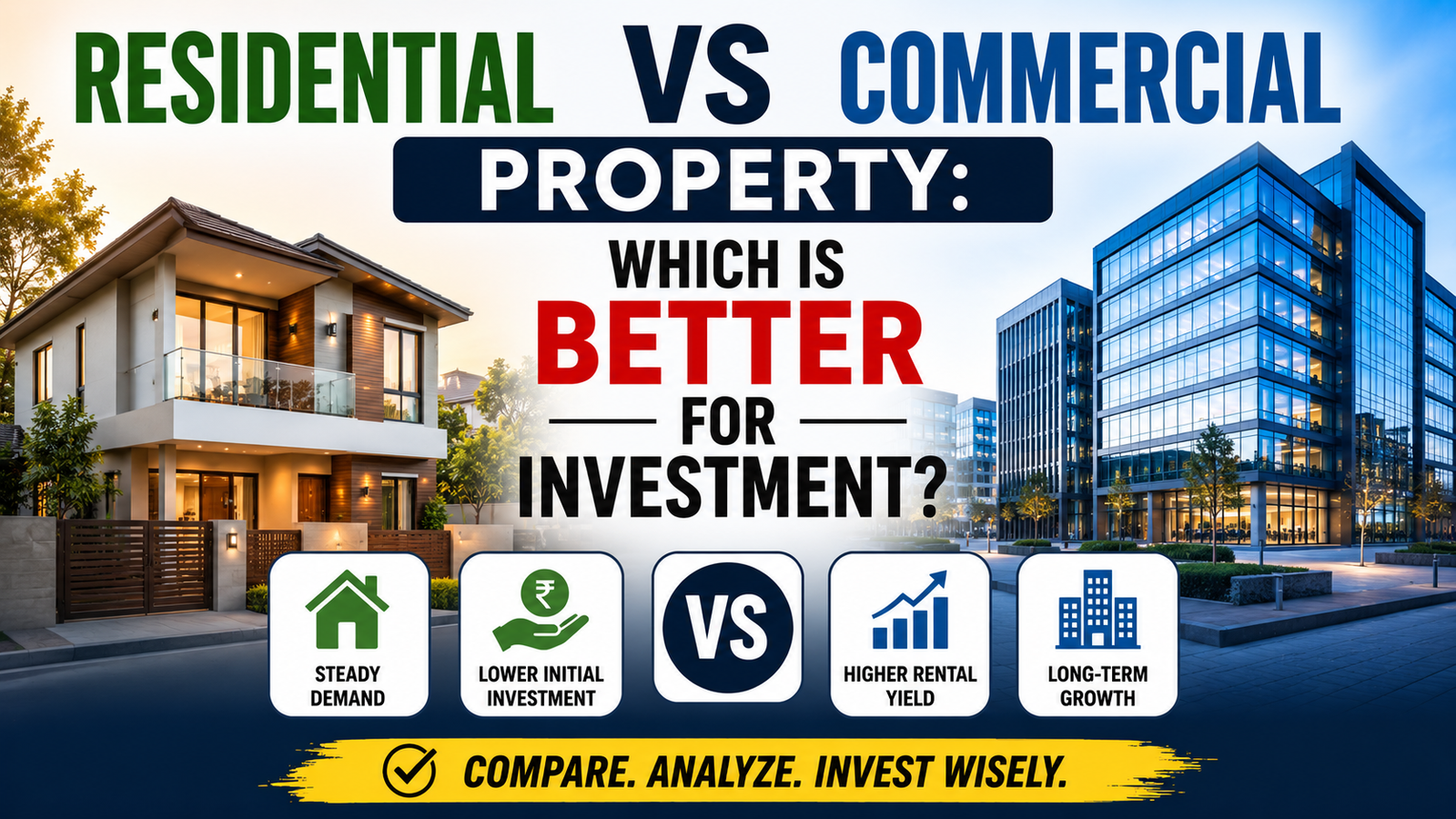
A flat can give you a steady tenant and a familiar resale market. A shop, office or commercial unit can bring higher rent, but it can also sit vacant for months if the location doesn’t work. So the better investment depends on what you’re trying to get from the property. If your priority is rental income, commercial property can look attractive.If you want a wider pool of tenants and buyers, residential property is usually easier to understand.
But there’s more to it than rent.
Table of Contents
Residential property: what are you actually buying?
Residential real estate includes properties such as:
- Flats
- Apartments
- Independent houses
- Builder floors
- Villas
- Residential plots
The biggest advantage is simple.
People always need places to live.
That creates a broad tenant market.
A 2BHK near a metro station, office hub, university or established neighbourhood can attract working professionals, couples and small families.
You don’t need a huge company to rent it.
A normal family can be your tenant.
Commercial property works differently
Commercial real estate can include:
- Shops
- Offices
- Showrooms
- Warehouses
- Commercial plots
- Retail spaces
The tenant usually cares about business activity.
Footfall matters.
Visibility matters.
Parking matters.
Road access matters.
A shop on a busy road can be worth far more than a larger shop hidden inside a quiet lane.
That’s why commercial property requires more location research.
A property can look excellent on paper and still struggle to find a tenant if customers don’t naturally pass through the area.
Rental income: commercial usually gets more attention
This is one reason investors consider commercial property.
Commercial properties can sometimes provide higher rental yields than residential properties.
But the word to focus on is sometimes.
You need to calculate the actual numbers for the specific property.
Suppose you buy a residential flat for ₹80 lakh and receive ₹25,000 rent per month.
Annual rent:
₹25,000 × 12 = ₹3 lakh
Gross rental yield:
₹3 lakh ÷ ₹80 lakh × 100 = 3.75%
Now suppose a commercial shop costs ₹80 lakh and generates ₹50,000 monthly rent.
Annual rent:
₹50,000 × 12 = ₹6 lakh
Gross rental yield:
₹6 lakh ÷ ₹80 lakh × 100 = 7.5%
The commercial property looks better on rental yield.
But that’s only the first calculation.
You still need to check vacancy, maintenance, taxes, brokerage, fit-out requirements and the quality of the tenant.
How to check property documents before buying a house in India 2026
Higher rent can come with higher vacancy risk
Imagine you own a commercial shop.
Your tenant runs a clothing store.
The business closes after 3 years.
Now the property is vacant.
You might spend months finding another tenant.
Your EMI continues.
Maintenance continues.
Property expenses continue.
The rental income has dropped to zero.
A residential property can also become vacant, of course.
But a well-located residential unit often has a larger pool of potential tenants.
That’s one reason residential property can feel easier for first-time investors.
Tenant demand is very different
For residential property, your potential tenant might be:
A family.
A couple.
A working professional.
A student.
For commercial property, your tenant might need a specific business location.
A restaurant needs visibility.
A clinic needs accessibility.
An office needs suitable infrastructure.
A warehouse needs road access and enough loading space.
So when you buy commercial property, ask:
Who exactly will rent this?
If the answer is vague, don’t rush.
Ready-to-Move vs Under-Construction Property: Which One Should You Buy?
Location matters differently for both
Residential property depends heavily on livability.
People care about:
- Metro connectivity
- Schools
- Hospitals
- Markets
- Safety
- Roads
- Public transport
- Nearby workplaces
Commercial property depends heavily on business activity.
Tenants may care about:
- Footfall
- Visibility
- Parking
- Road frontage
- Nearby businesses
- Customer access
- Public transport
- Local purchasing power
The same road can work brilliantly for one property type and poorly for another.
A residential apartment beside a busy commercial market might have noise problems.
A retail shop in that same market could benefit from the footfall.
That’s why you can’t judge a location without considering the property type.
Residential property is usually easier for beginners
If this is your first real estate investment, residential property can be easier to understand.
You can compare similar flats in the same society.
You can check current rents.
You can speak to residents.
You can look at nearby resale listings.
You can estimate your likely tenant.
Commercial property can require more research.
A shop may have a higher rent, but you need to understand why the tenant is willing to pay it.
Is the property on a busy road?
Does the area have strong customer demand?
Are nearby shops occupied?
How long have existing tenants stayed?
These questions matter.
Commercial property needs a stronger location
This is where many investors make mistakes.
They see a shop with a large promised rental yield and assume it’s a good deal.
Then they visit the location.
The road is quiet.
Parking is difficult.
Half the nearby shops are empty.
The property has been vacant for 8 months.
Suddenly the attractive rental calculation doesn’t look so attractive.
Before buying commercial property, visit the area during business hours.
Then visit again in the evening.
Look at actual footfall.
Talk to shopkeepers.
Ask how long businesses usually stay.
You’ll learn more from 30 minutes on the street than from a glossy brochure.
Who is paying the rent?
This question matters.
Residential tenants generally pay rent from their household income.
Commercial tenants pay rent from business revenue.
A business can perform well for years.
It can also shut down.
If you’re buying commercial property, understand the type of business likely to occupy the space.
A medical clinic may have different stability from a seasonal retail business.
An established office tenant may have a different lease profile from a new startup.
The tenant matters almost as much as the property.
Lease terms can change the calculation
Commercial properties often involve longer leases and more detailed agreements.
You may see arrangements involving:
- Security deposits
- Lock-in periods
- Rent escalation
- Maintenance responsibilities
- Fit-out periods
- Renewal terms
- Notice periods
Read the agreement carefully.
Suppose a commercial tenant signs a 5-year lease with a 3-year lock-in period.
That can give you more rental visibility than a tenant who can leave quickly.
But every agreement is different.
Get the lease reviewed by a property lawyer before relying on its terms.
Residential tenants can change more frequently
A residential tenant might move because of:
- Job transfer
- Marriage
- Family changes
- Buying their own home
- Changing cities
That means you may need to find a new tenant more frequently.
You can also face costs between tenants.
Painting.
Cleaning.
Minor repairs.
Brokerage.
A month of vacancy.
These expenses reduce your actual rental return.
So when comparing residential and commercial properties, use net rental income, not just the advertised monthly rent.
Calculate the real rental yield
Let’s say a flat costs ₹75 lakh.
Monthly rent is ₹25,000.
Annual rent:
₹3 lakh
Now suppose your yearly expenses are:
- Maintenance: ₹30,000
- Repairs: ₹15,000
- Property-related expenses: ₹10,000
Your approximate income after these expenses becomes:
₹3,00,000 – ₹55,000 = ₹2,45,000
Your net yield is lower than the initial 4% figure.
Do the same calculation for commercial property.
The property with the higher advertised rent isn’t automatically the better investment.
What about capital appreciation?
Rental income is only one part of a real estate investment.
The property might also increase in value.
Suppose you buy a property for ₹60 lakh.
After 8 years, it’s worth ₹90 lakh.
Your price increase is:
₹30 lakh
Now add the rental income you’ve collected over those 8 years.
Then subtract your costs.
That gives you a much clearer picture of the investment.
But don’t assume appreciation will follow the same path every year.
Real estate prices can remain flat in some areas for long periods.
Location matters heavily.
Commercial property can have strong appreciation too
Commercial property can benefit when business activity grows around it.
A new office district can increase demand for nearby shops.
A new metro station can improve access.
A growing residential population can create demand for local retail.
But the opposite can happen too.
If businesses leave the area or a competing commercial centre opens nearby, demand can weaken.
Your investment depends on the local economy.
That’s why buying a commercial property purely because “commercial gives higher returns” is a weak strategy.
Stamp Duty & Registration Charges
What about resale?
Residential property usually has a larger pool of potential buyers.
A family can buy the flat for personal use.
An investor can buy it for rent.
A parent can buy it for their child.
Commercial property has a more specific buyer pool.
A buyer might ask:
“What business can operate here?”
“What rent does it generate?”
“How strong is the location?”
“Is the tenant reliable?”
“What’s the lease?”
That can make commercial resale more dependent on the property’s income potential.
Rera for Protect Propety Buyer
Liquidity matters
Real estate isn’t a liquid investment.
You can’t sell half a shop because you suddenly need ₹20 lakh.
You have to sell the property or arrange money somewhere else.
Residential property can sometimes have a broader buyer pool.
Commercial property can take longer to sell if the price is high or the location has weak demand.
So keep some cash outside the property.
Don’t put every rupee into real estate.
Loan considerations are different
If you’re using a home loan to buy residential property, you may have access to loan products designed specifically for residential purchases.
Commercial property financing can have different eligibility rules, interest rates, loan-to-value limits and repayment terms.
Don’t assume the financing will work the same way.
Before booking a property, ask the lender:
- How much can I borrow?
- What interest rate applies?
- What tenure is available?
- What processing charges apply?
- What documents are required?
- Are there any prepayment conditions?
- What happens if the property remains vacant?
Calculate the EMI before signing anything.
A higher rent doesn’t mean a better investment
This deserves repeating.
Suppose:
Residential property
Price: ₹80 lakh
Rent: ₹25,000/month
Commercial property
Price: ₹80 lakh
Rent: ₹50,000/month
Commercial looks better.
But imagine the commercial property remains vacant for 6 months every 3 years.
Your actual annual income falls.
Now add brokerage when finding a new tenant.
Then add maintenance.
Then add periods when the tenant requests fit-out time.
The gap can become much smaller.
Always calculate the income you realistically expect to collect.
Think about who you are
Your own situation should influence the choice.
If you’re a first-time investor with limited experience, residential property can be easier to manage.
If you already own residential property and understand commercial leasing, a shop or office could make sense.
If you need predictable occupancy, look closely at residential demand.
If you’re comfortable with higher vacancy risk in exchange for potentially higher rent, commercial property may deserve a closer look.
There’s no universal winner.
When residential property can make more sense
Residential property may suit you if:
- You want a wider tenant pool.
- You plan to hold the property for several years.
- You want to use the property yourself later.
- You’re buying your first investment property.
- The location has strong family demand.
- You want a simpler rental arrangement.
A well-located 2BHK near employment centres can be a practical investment.
You know who your tenant is.
You can check comparable rents.
And you can physically see similar properties being occupied.
When commercial property can make more sense
Commercial property may suit you if:
- The location has strong business activity.
- You understand the local market.
- The property has clear rental demand.
- The tenant profile is strong.
- The lease terms are suitable.
- You can handle vacancy periods.
- You have enough cash to cover the property when it’s empty.
A shop in an established market can work very differently from a shop inside an unfinished commercial project.
Study the exact property.
Don’t judge the category alone.
Don’t ignore under-construction commercial projects
This is another area where buyers need to be careful.
A developer might show a future commercial complex with restaurants, offices and hundreds of shops.
It looks busy in the brochure.
But your investment depends on what actually gets built and whether businesses eventually move in.
Check the project’s approvals, RERA details where applicable, construction status, delivery history of the developer and existing demand in the surrounding area.
A commercial project needs businesses.
Without them, high rental projections don’t mean much.
Check the documents
Whether you’re buying residential or commercial property, paperwork matters.
Before paying a major amount, check documents related to:
- Ownership
- Title
- Encumbrances
- Approved plans
- Land use
- Property tax
- Building permissions
- Completion or occupancy status where applicable
- RERA registration where applicable
- Society or association records
The exact documents depend on the property.
Get a qualified property lawyer to verify them.
A property that looks cheap can become very expensive if there’s a legal problem attached to it.
Compare both investments using the same numbers
Here’s a simple comparison.
| Factor | Residential | Commercial |
| Tenant pool | Usually wider | More specific |
| Rental yield | Often lower | Can be higher |
| Vacancy risk | Usually easier to manage | Can be higher |
| Tenant changes | Can happen more frequently | Leases can be longer |
| Location need | Livability | Business activity |
| Resale pool | Usually broader | More specialised |
| Management | Often simpler | Lease terms can be more complex |
| Entry cost | Depends on location | Can be high |
| Personal use | Possible | Usually limited |
These are general patterns.
A specific commercial property can be safer than a specific residential property, and the reverse can also happen.
The property itself decides the result.
A practical way to choose
Before buying either type, write down these numbers:
Purchase price
Down payment
Loan amount
EMI
Monthly rent
Annual rent
Maintenance
Expected vacancy
Property tax
Brokerage
Other yearly expenses
Then calculate the expected annual return.
After that, ask a more practical question:
Who will rent this property if I had to find a tenant tomorrow?
If you can answer that clearly, you’re getting somewhere.
If you can’t, keep researching.
Residential vs commercial: which one should you choose?
For a first-time real estate investor, I’d generally lean toward residential property in a location with established rental demand.
It’s easier to understand.
You have more potential tenants.
You can compare rents quickly.
And the resale market is usually easier to assess.
Commercial property can be attractive when you’ve found a genuinely strong location with reliable tenant demand and sensible pricing.
The rental yield can be higher.
But the risks need more attention, especially vacancy and tenant quality.
So don’t choose commercial property simply because someone says, “Commercial gives 8% rent.”
Check how that 8% is calculated.
Check whether the tenant is actually paying it.
Check how often similar units remain vacant.
Check what happens if the tenant leaves.
The better investment is the property where the rent, price, location and future demand all make sense together.
And before you sign anything, calculate the numbers using a realistic vacancy period.
That’s where the real comparison starts.
Disclaimer: This article is for general educational purposes and doesn’t constitute financial, legal or tax advice. Rental yields, property prices, taxes, financing costs, regulations and market conditions vary by location and property type. Verify property documents and applicable approvals before purchasing. Consult qualified legal, financial and tax professionals for advice based on your individual circumstances.
Residential or commercial property better for investment?
Residential property is usually easier for beginners, while commercial property may offer higher rental income but can require more investment.
Which property has better rental returns?
? Commercial properties often offer higher rental yields, but returns depend on location, tenant demand, property type, and purchase price.
Pingback: Home loan EMI vs rent: When does buying a house make financial sense?