
Choosing a home gets complicated when you have 3 very different options sitting in front of you.
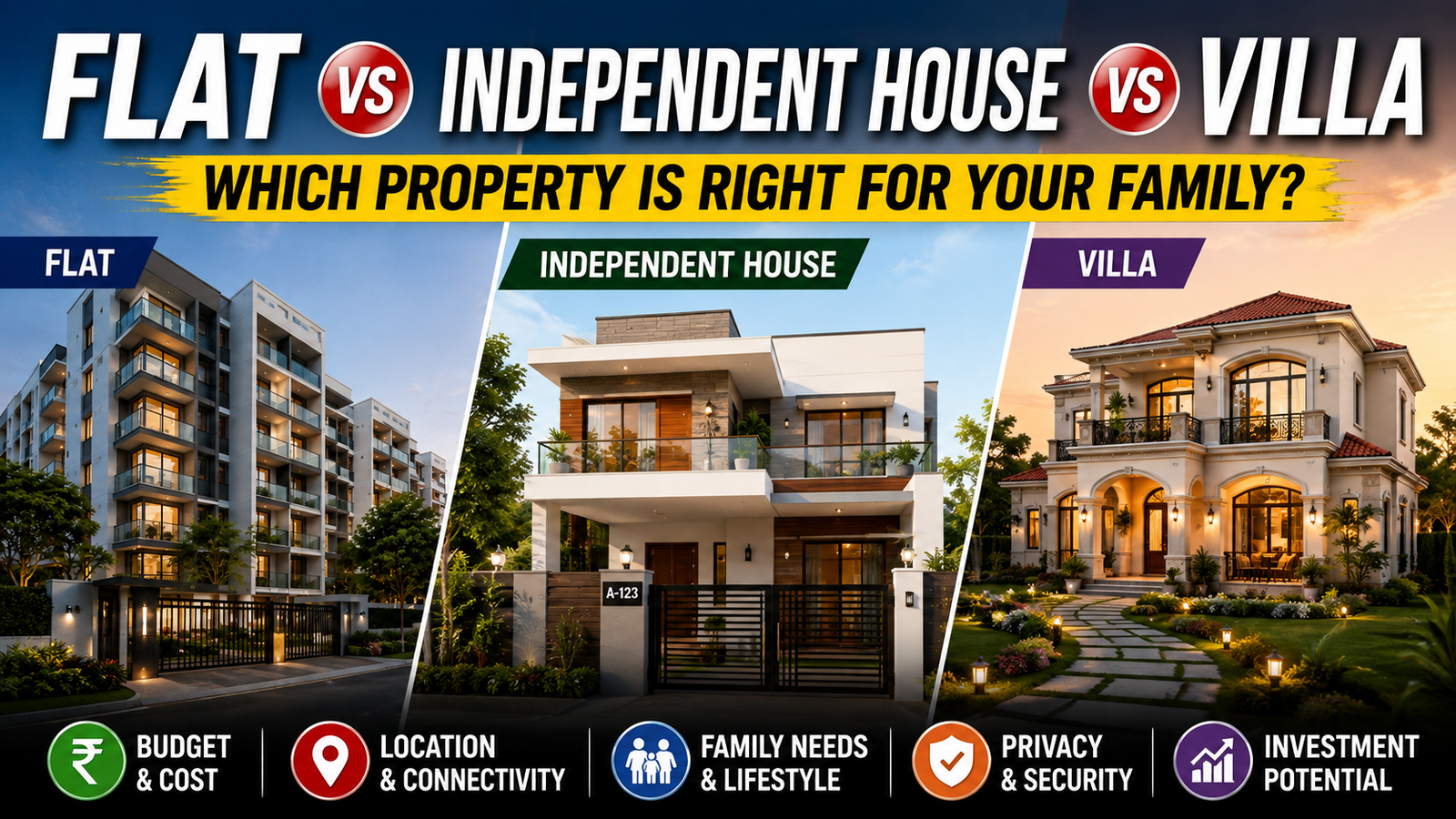
A flat might give you security, shared facilities and easier maintenance. An independent house gives you more control over the property. A villa sits somewhere in between, with private space and a planned community around you.
So which one should you buy?
It depends on how your family actually lives.
A family with 2 working parents and young children might value security and a nearby school. Someone planning to stay in the same property for 20 years might care more about land, privacy and the ability to change the house later.
The price matters, too. But don’t stop at the purchase price.
Flat vs independent house vs villa at a glance
| Factor | Flat | Independent house | Villa |
| Privacy | Moderate | High | High |
| Maintenance | Usually easier | Higher responsibility | Usually shared for common areas |
| Land ownership | Usually shared proportionately | Direct land ownership | Usually includes land rights as per documents |
| Security | Often managed by society | Owner manages security | Usually community security |
| Facilities | Often available | Usually private | Often available |
| Customisation | Limited by society/building rules | High | Moderate to high |
| Neighbours | Close | More separation | More separation |
| Upfront cost | Often lower | Can be high | Usually higher |
| Rental demand | Often strong in urban areas | Depends heavily on location | Depends on location |
| Best for | Convenience and city living | Space and control | Space with community living |
Start with your family’s daily life
Before comparing floor plans, think about a normal Tuesday.
Where does everyone work?
Where do the children go to school?
How long is the commute?
Do your parents live with you?
Do you need a separate office?
Do you have a car, 2 cars, or maybe a future car?
These questions tell you more about the right property than a glossy brochure.
A 2,000 sq. ft. house sounds great until you’re spending 2 hours every day travelling to work.
And a beautiful 3-bedroom flat might feel cramped if 5 family members need separate rooms.
Start with your routine.
Then choose the property.
What is a flat?
A flat is an individual residential unit inside a larger building or residential project.
You own your unit along with the rights attached to it under the relevant property documents. Common areas such as corridors, lifts, gardens and other shared facilities are generally managed collectively through the society, association or other applicable structure.
For many families, that’s a big reason to choose an apartment.
You don’t have to worry about every part of the building yourself.
If a lift stops working, there’s a maintenance system.
If security is needed at the entrance, the society usually handles it.
If the garden needs maintenance, you don’t have to personally call a gardener.
That convenience has a cost, though.
You pay maintenance charges and follow society rules.
Advantages of buying a flat
1. Maintenance is easier
You generally don’t have to handle the entire building yourself.
Common-area maintenance, security, lifts and other shared facilities are usually managed through the society or association.
That’s useful if you’re busy or don’t want property maintenance eating into your weekends.
2. Security is usually easier
Many apartment projects have controlled entrances, guards, CCTV and security systems.
You still need to check how well those systems actually work.
A security guard at the gate doesn’t automatically mean the building is secure.
Ask residents about it.
3. You get shared facilities
Depending on the project, you might get access to:
- Gym
- Park
- Clubhouse
- Swimming pool
- Children’s play area
- Community hall
- Walking areas
These facilities can be useful for families with children.
But check the maintenance cost before getting excited about the clubhouse.
A swimming pool you use twice a month still costs money to maintain.
4. Flats can work well in cities
If you want to stay close to offices, schools, hospitals and public transport, apartments can give you more choices.
Land is expensive in established urban areas, so vertical housing makes better use of limited space.
That’s one reason apartments are common in large cities.
Drawbacks of a flat
Less privacy
You share walls, corridors, lifts and common spaces with other residents.
You might have a quiet neighbour.
You might also have the neighbour who starts drilling at 8:05 AM on Sunday.
You can’t control everything around you.
Society rules
You may have rules covering renovations, pets, parking, noise, exterior changes and other matters.
Before buying, ask for the society’s rules.
Don’t assume you can change everything inside or outside the apartment whenever you want.
Maintenance charges
Monthly maintenance can become a meaningful expense over 10 or 15 years.
Ask what you’re paying for and whether additional charges are expected for major repairs.
What is an independent house?
An independent house is a standalone residential property where the owner generally has direct rights over the house and the associated land, subject to the property’s title and applicable local rules.
You have more control.
Want to renovate the kitchen?
You have more freedom.
Want to create a garden?
You have your own land to work with.
Want another floor?
That’s where things get interesting.
You can’t simply add a floor because you own the house. Local building rules, approved plans, structural capacity and other permissions still apply.
So ownership gives you control, but it doesn’t remove regulations.
Advantages of an independent house
1. More privacy
You don’t have another family living directly above you.
There are no shared corridors outside your bedroom.
For large families, that can make a noticeable difference.
2. More control over the property
You usually have more freedom to change the house, subject to local rules and approvals.
You can redesign rooms, modify the kitchen, create a garden or make other changes that fit the property and applicable regulations.
3. Land can matter
With an independent house, you’re buying a property that includes land rights according to the title documents.
That can matter for long-term ownership.
The building itself ages.
Land is a different part of the equation.
4. Better for large families
If your parents live with you, children need space, or you want separate rooms for work and guests, an independent house can be easier to arrange.
You can spread the family across multiple floors.
Drawbacks of an independent house
Maintenance is your responsibility
The roof leaks?
You handle it.
The boundary wall needs repair?
You handle it.
The plumbing breaks?
You call someone.
There isn’t a society manager you can email and forget about it.
Read Our Latest Posts
- Sitting in Your Current Home and Thinking, “How Much Would I Have to Invest to Make My Home 10X Bigger?”
- What Adds the Most Resale Value to a House?
- Carpet Area vs Built Up Area: What Home Buyers Should Actually Compare
- Why Two Identical Flats in the Same Society Can Have Different Values
- The ₹50 Lakh Home Trap: What Your Actual Buying Budget Looks Like in India
- The Hidden Property Cycle Behind REIT Returns: How Occupancy, Rent Growth and Interest Rates Move Your Investment
- What Will Homes Look Like in 2035? 15 Housing Trends Already Taking Shape
- How AI Is Changing the Way People Search for Homes in 2026
- Top 50 countries with the highest homeownership rates in the world
- Property Day Checklist: What to inspect in india 2030
- Buying vs Renting in India vs Dubai: Where Does Your Money Go Further in 2050?
- India vs Australia Real Estate 2026: Which Property Market Makes More Sense for Investors?
- Home loan EMI vs rent: When does buying a house make financial sense?
- Stamp duty and registration charges in India: What home buyers need to know
- What is RERA and how does it protect property buyers in India?
Security needs more planning
You need to manage your own security arrangements.
Depending on the location, that might mean CCTV, alarms, gates, guards or other measures.
Location can become expensive
Independent houses in established city areas can be very expensive because you’re paying for land.
A house in a prime part of Delhi can cost far more than an apartment with similar built-up space.
That’s why you need to compare the land value and location rather than simply comparing square footage.
What is a villa?
A villa usually gives you a private house within a planned residential development.
You might have your own entrance, garden, parking and multiple floors, while the larger community handles shared infrastructure and facilities.
The exact ownership structure varies from project to project.
Read the documents carefully.
Some villa projects provide clear rights over the plot and structure. Others have different arrangements involving common areas, maintenance and land.
Don’t assume every villa project works the same way.
Advantages of a villa
Private space
You get many of the privacy benefits of an independent house.
You can have your own garden, terrace or parking area depending on the property.
Community facilities
Many villa communities have:
- Clubhouses
- Parks
- Security
- Walking tracks
- Sports facilities
- Children’s areas
That combination can work well for families.
You get private space while still having a residential community around you.
Good family environment
For families with children, a gated villa community can be attractive.
Kids can have common areas to play, and parents may prefer controlled access compared with an open neighbourhood.
But visit the project before deciding.
A brochure can’t tell you whether the internal roads are busy at 7 PM or whether the play area is actually being used.
Flat vs house vs villa: what about cost?
This is where comparisons can get misleading.
Suppose you see:
- Flat: ₹80 lakh
- Villa: ₹1.5 crore
- Independent house: ₹2 crore
The independent house looks expensive.
But you’re also buying different amounts of land, privacy and control.
So compare the total ownership cost, not just the purchase price.
Think about:
- Purchase price
- Stamp duty
- Registration
- Home loan interest
- Maintenance
- Property tax
- Repairs
- Interiors
- Security
- Parking
- Renovation
- Future maintenance
An independent house might have no monthly society maintenance, but that doesn’t mean maintenance is free.
The roof, plumbing, electrical system, walls and exterior all need money over time.
A flat might have a monthly maintenance bill but fewer individual repair responsibilities.
Which property is better for a nuclear family?
A flat usually works well for a small nuclear family that wants convenience.
If both parents work, having security, maintenance staff, a lift and nearby facilities can save time.
A 3-bedroom flat can also give children their own rooms while keeping the family together.
If you don’t need a large private outdoor area, an apartment can make financial sense.
Which property is better for a joint family?
An independent house or villa often makes more sense for a larger family.
Parents can have their own floor.
Children can have separate bedrooms.
Guests can stay without taking over the living room.
And there’s more room for family gatherings.
But think about accessibility.
If elderly parents live with you, stairs can become a problem in a multi-storey house.
A ground-floor bedroom or lift can make the property much easier to live in.
What if you work from home?
This is becoming a major consideration.
If you work from home every day, you need a proper workspace.
A flat can work perfectly well if you have an extra bedroom that can become an office.
An independent house gives you more options.
You might have an entire room, floor or section of the house for work.
A villa can give you similar flexibility.
But there’s another issue: noise.
A large house near a busy road isn’t automatically better for remote work than a well-insulated apartment.
Visit the property during your actual working hours.
What about children?
Think beyond the size of the bedroom.
Children need usable space.
A flat inside a family-oriented society might give them access to parks, play areas and other children.
A villa community can provide similar benefits with more private space.
An independent house gives you greater control over your own outdoor area, but your child may not have the same number of children nearby.
Ask yourself what your children actually need.
A huge lawn isn’t much use if there’s nowhere for them to meet other kids.
Parking can change the decision
Don’t treat parking as an afterthought.
Ask:
Where will both cars be parked?
If you have 1 car today and expect another in 3 years, plan for it now.
In a flat, check whether parking is allotted, how many spaces you get and what the documents say.
For an independent house, check the actual parking space and road access.
For a villa, check whether parking is inside the property or in a designated common area.
And visit during the evening.
That’s when parking problems usually introduce themselves.
Privacy: flat vs house vs villa
If privacy is your biggest priority, an independent house usually wins.
A villa comes close.
A flat gives you less physical separation because you’re living inside a shared building.
But privacy isn’t only about walls.
It’s also about the neighbourhood.
A flat on the top floor with good sound insulation might feel more private than a poorly planned independent house beside a busy road.
Visit before buying.
Spend 15 minutes inside without the salesperson talking.
Listen.
You’ll learn a lot.
First-Time Home Buyer Guide
Maintenance: who wants to handle it?
This is an underrated question.
Ask yourself how much property work you’re comfortable handling.
With a flat, common maintenance is usually organised through the society or association.
With an independent house, you’re responsible for almost everything.
With a villa, you’ll usually have both private maintenance and community maintenance.
If you hate dealing with plumbers, electricians and repair workers, an independent house may frustrate you.
If you enjoy managing your own property, the extra control might be worth it.
What about resale value?
No property type automatically gives better returns.
Location matters enormously.
A ₹1 crore flat in a well-connected area can be easier to sell than a ₹1.5 crore villa far away from major employment centres.
For resale, look at:
- Location
- Road access
- Nearby infrastructure
- Property age
- Builder reputation
- Maintenance
- Parking
- Layout
- Local demand
- Rental demand
For independent houses, land value can play a large role.
For flats, the building’s age and maintenance become more important.
For villas, both the land component and the condition of the community matter.
What about rental income?
If you’re buying partly as an investment, check the local rental market.
Don’t calculate rent based on what the broker tells you.
Look at actual comparable properties.
Suppose you’re considering a ₹90 lakh flat and similar units are renting for ₹25,000 a month.
Annual rent would be:
₹25,000 × 12 = ₹3 lakh
That’s roughly 3.3% of the purchase price before considering vacancy, maintenance, taxes and other expenses.
Now compare that with a villa in the same area.
If the villa costs ₹1.8 crore but rents for ₹40,000 a month, the rental return might be lower despite the higher monthly rent.
Do the calculation.
The bigger property isn’t automatically the better investment.
Think about your next 10 years
Your home needs to fit your future plans.
If you’re 30 and buying your first home, think about what your family might look like at 35.
Will you need another bedroom?
Will your parents move in?
Will you need a home office?
Will you buy another car?
Could your job move to another part of the city?
You don’t need to predict everything.
Just avoid buying a property that already feels tight.
A quick decision guide
Choose a flat if you want:
- Easier maintenance
- Strong security arrangements
- Shared facilities
- City connectivity
- A relatively simple ownership setup
Choose an independent house if you want:
- Maximum privacy
- More control
- Private outdoor space
- Greater freedom to modify the property
- Land ownership according to the title
Choose a villa if you want:
- Private home space
- A gated community
- Shared facilities
- More privacy than a flat
- Less responsibility for common infrastructure
A practical example
Let’s say a family of 4 is choosing between 3 properties.
Option 1: 3-bedroom flat, ₹85 lakh
The office is 8 km away. School is 3 km away. The building has security, a park and a clubhouse.
Maintenance is ₹5,000 per month.
Option 2: Independent house, ₹1.4 crore
The house has 3 bedrooms, a small garden and 2 parking spaces.
The office is 18 km away.
There is no society maintenance, but the family handles repairs and security.
Option 3: Villa, ₹1.25 crore
The villa has 3 bedrooms, a small private garden and access to a gated community.
The office is 15 km away. The project has maintenance charges and community facilities.
Which one is best?
There isn’t a universal answer.
If the family values commute and convenience, the flat might win.
If privacy and land matter most, the independent house could be worth the extra money.
If they want private space while still having a managed community, the villa might fit better.
The right answer comes from the family’s actual routine.
Don’t buy square feet. Buy a lifestyle you can afford.
A 2,500 sq. ft. house sounds impressive.
But if the EMI consumes most of your monthly income, the extra space won’t feel very impressive when the bills arrive.
Work out your budget first.
Then decide what type of property fits inside it.
Keep some money aside for emergencies, interiors, repairs and other ownership costs.
Your house shouldn’t leave you with no financial breathing room.
How to check property documents before buying a house in India 2026
Final checklist before you choose
Before booking a flat, house or villa, ask yourself:
- Can I comfortably afford the total cost?
- How long will my daily commute be?
- Do I need private outdoor space?
- How much maintenance can I handle?
- Do my parents need easy access?
- Will my family need another bedroom later?
- How many cars will we have?
- What are the society or community rules?
- What are the monthly maintenance costs?
- What does the property’s legal paperwork say?
- Is the location good for resale and rental demand?
- Have I visited the property at different times of day?
Then make the decision.
For many urban families, a flat is the practical choice.
For families who want privacy and control, an independent house can be worth the extra work.
And for someone who wants a private home inside a managed community, a villa can hit the middle ground.
The best property is the one that fits your family, your budget and the way you actually live.
Disclaimer: This article is for general educational purposes and doesn’t constitute legal, financial or tax advice. Property prices, taxes, registration charges, local building rules, ownership structures and housing regulations vary by location and property type. Verify the relevant documents and local requirements with the appropriate authority and consult a qualified property lawyer or financial professional before making a property purchase.
Which is better a flat, independent house, or villa?
It depends on your budget, family needs, privacy, and preferred location. A flat is usually easier to maintain, while an independent house or villa offers more space and privacy.
Which property type is better for investment?
A flat can be easier to rent and may have better demand in well-connected areas. However, independent houses and villas can offer strong long-term value depending on the location.
Pingback: How much home loan can you afford? A practical property budget guide 2026